Noté 5 sur 5 étoiles.
Avis 1-4 de 4
Noté 5 sur 5 étoiles.
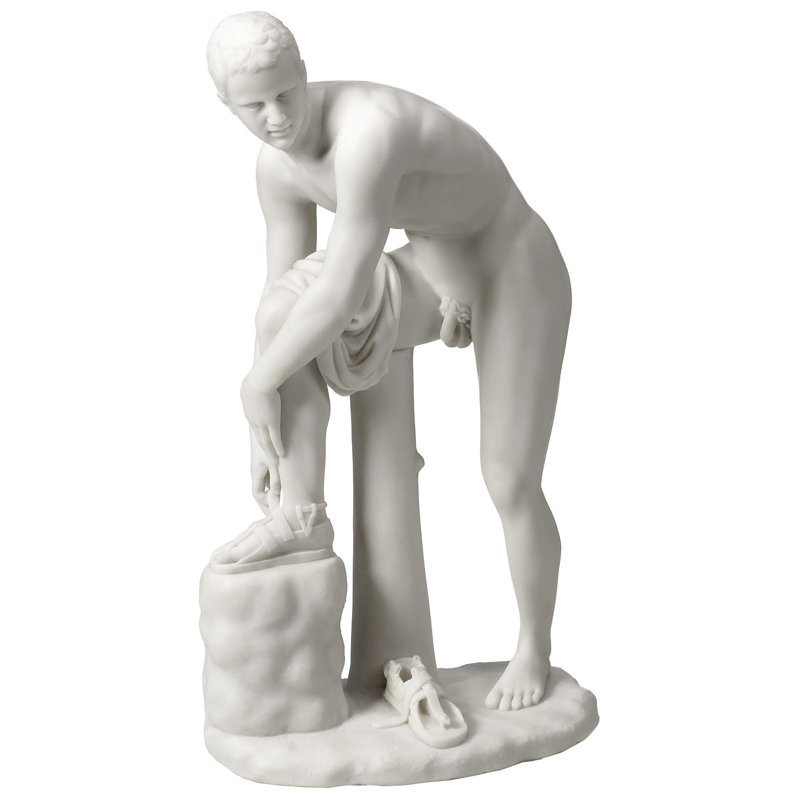
As an inveterate lover of ancient Greek, Hellenistic, Etruscan, and Roman sculpture and classical art, the purchase of the Camie statue depicting the Greek god Hermes (Mercury) was a natural choice. I saw this exemplary stunning Roman copy of the Hellenistic original by the 4th-century BC master Lysippus at the Musée du Louvre in Paris. It's a beautifully rendered, small-scale copy of that masterpiece. I couldn't be more thrilled about my decision to purchase it for my space. Note: From a historical standpoint, three of the most visually compelling aspects of Hellenistic sculpture are its rigid adherence to the formulaic principles of symmetrical balance; mathematically precise ratios of proportion—and aesthetic corporeal harmony. The same can be said about the Classical period, which began in the mid-5th century BC, and this design trifecta continued into the Hellenistic period (323–30 BC) following Alexander the Great's death in June 323 BC, with one divergent exception—that being the old concept of the immobile constraint, stylized idealization of the human form—which readily defines classical sculpture, versus that of vigorous natural realism that became the new idea that would single-handedly transform Hellenistic sculpture as witnessed by this brilliantly masterful example.
Noté 5 sur 5 étoiles.
Got it - love it - it fits right where I wanted it to go - thank you!
Noté 5 sur 5 étoiles.
Great detail beautiful art.
Noté 5 sur 5 étoiles.
Livraison gratuite
Recevez-le entre le 31 juill.-4 août
à
M4C 1B5

Matériau: Résine

Accumulez {RICH_TEXT_POTENTIAL_REWARDS} en récompenses, avec une remise de 5 %¹, en plus d’autres avantages exclusifs.

À propos de ce produit
Caractéristiques
Autres dimensions
Détails
Garantie
Pas convaincu? Les retours sont offerts pour la plupart des articles dans les 30 jours suivant la livraison pour un remboursement ou un bon d'achat.
Apprenez-en plus