Livraison gratuite
Recevez-le d'ici le 13 oct.
à
M4C 1B5

Chauffé

Garantie: Garantie complète

Assemblage nécessaire

Emplacement: Intérieur / extérieur

Accumulez {RICH_TEXT_POTENTIAL_REWARDS} en récompenses, avec une remise de 5 %¹, en plus d’autres avantages exclusifs.

À propos de ce produit
Caractéristiques
Dimensions du produit
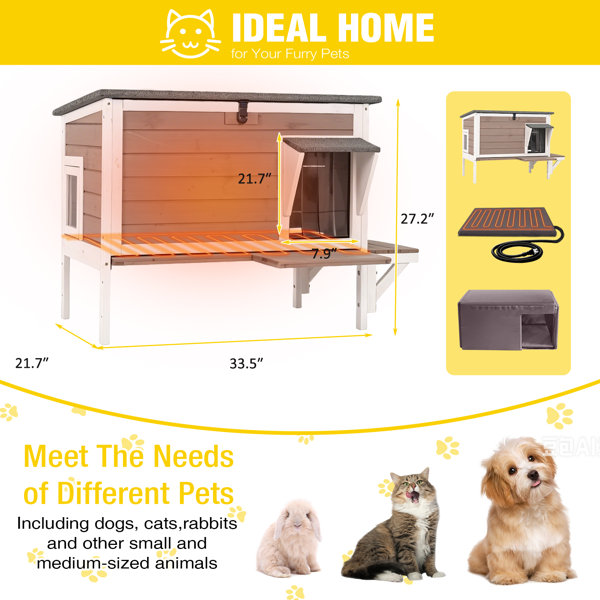
Autres dimensions
Détails
Assemblage
Garantie
Pas convaincu? Les retours sont offerts pour la plupart des articles dans les 30 jours suivant la livraison pour un remboursement ou un bon d'achat.
Apprenez-en plusNoté 4.6 sur 5 étoiles.
Avis 1-5 de 54
Noté 5 sur 5 étoiles.
I purchased three cat houses without the electric heating pads in August 2025. I wanted to provide year-round shelter for several semi-feral cats. One reason I chose these houses was that I could use the included insulation during the winter and remove it during the warmer months. I live in western North Carolina. After some trial and error, this is what worked for me. The cats used all three houses regularly last winter. 1. **Use the extra board to make the entrance smaller.** I cut the board that comes with the house to fit the width of the doorway and used extra screws to attach it across the bottom front. This helped keep the straw inside and reduced drafts. 2. **Put insulation underneath the floor in winter.** This made a noticeable difference. The cats preferred the houses that had something insulating them from the cold underneath, so eventually I did all three this way. In one location I used pine straw underneath the house. In another, I put straw inside a cardboard box beneath it. It isn't pretty, but it helps keep the cold from coming up through the floor. 3. **Use real straw for bedding.** Depending on the season, I used approximately 2–8 inches of straw inside each house. Do not use sleeping bags, blankets, hay (nay!), or decorative straw. If fabric gets wet during cold or freezing weather, it will not keep a cat warm and can actually become dangerous. Buy a bale of real straw from a feed or hardware store. Mine costs about $16. I changed the straw every few weeks and adjusted the amount as the seasons changed. Manufacturers do not recommend putting straw over a heated pad, so only use straw if you are **not** using the electric heating pad. I chose straw instead of a heating pad, following recommendations from cat rescue organizations for outdoor winter shelters. 4. **I taped the little swinging doors shut during winter.** I used painter's tape so I could easily remove it when the weather warmed up. I wasn't particularly concerned about predators in winter where my shelters were located, and blocking the doors helped reduce drafts and allowed me to pile the straw higher. 5. **I taped the two floor pieces together.** The floor comes in two sections, and I didn't want them gradually sliding apart. 6. **I did not use electric heating pads.** My usable outdoor electrical outlets were damaged during Hurricane Helene. Instead, on particularly cold nights I used palm-sized 18-hour hand warmers, activated them, tucked them securely inside socks, and placed them in the shelters. I generally used one when temperatures were around 23–35°F, two around 15–25°F, and three around 5–15°F. 7. **Location helps.** I think these shelters would do fine tucked into a reasonably protected outdoor location, and the asphalt roofs handle rain well. I especially wanted protection from winter wind, so I placed two houses inside my carport and one underneath my back stairs. 8. **Assemble them somewhere you don't mind getting a little messy.** I would not put these together in your living room unless it is also your project room! The asphalt roofing sheds some loose granules during assembly. 9. **Give the cats time to discover them.** I assembled mine in September 2025 and let the cats explore them on their own. Eventually, they decided the houses were theirs and began sleeping in them regularly. Once the weather warmed up, I removed the insulation, opened the little doors again, and reduced the bedding. The cats aren't using the houses much during the summer, but that is exactly what I expected. Overall, these worked very well for what I wanted: adaptable, year-round shelters that I could modify for western North Carolina winters and summer thunderstorms. With a few simple adjustments, all three became regularly used winter houses for my semi-feral cats.
Noté 3 sur 5 étoiles.
The idea is great but material very thin cheap wood!
Noté 5 sur 5 étoiles.
We had won the trust of an outside dweller for a number of years so we've gone through some houses. This one was the best with the insulated pads (we also put a heating pad in).
Noté 3 sur 5 étoiles.
It was pretty easy to build,i did it buy myself. It could be painted nicer but overall its worth the money.
Noté 5 sur 5 étoiles.
This is wonderful for my outdoor kitties.


