How to Choose the Best Desk Size for Your Workspace
Pick the desk dimensions that work for you.
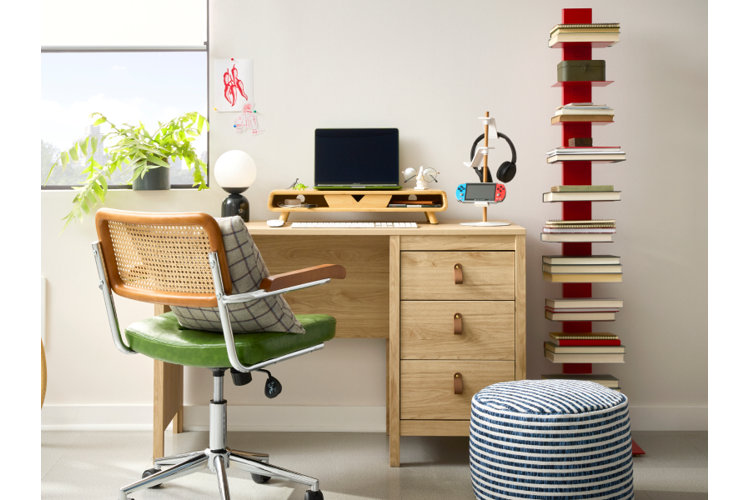
To encourage the most productivity, you want to choose a desk size that provides enough room to store your work or study essentials. Standard desk sizes range from 48" – 72" wide, 24" – 36" deep, and 28" – 30" high. Small desks under 40" wide are great for compact spaces, while large desks over 60" wide are best for large home offices. Follow these steps to find out which desk dimensions are right for your workspace.
Step 1: Choose a Location & Measure Your Space
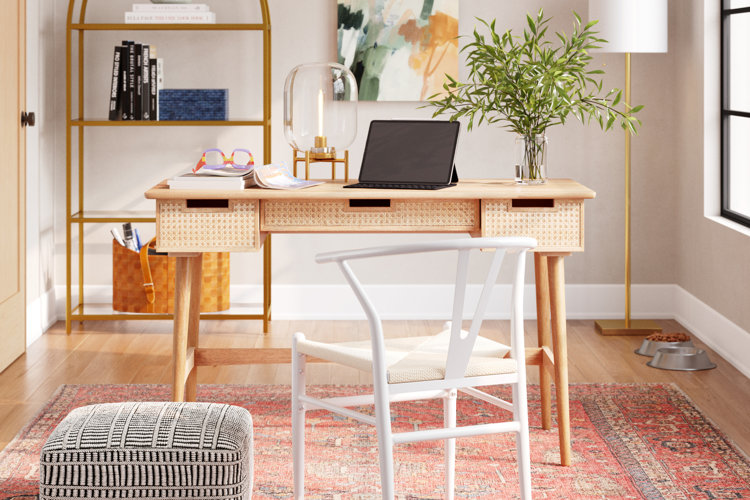
First, consider where you want to place your desk. It could be in a home office, tucked behind a sofa, in an empty nook, or anywhere you feel like you would work best. Then, use a tape measure to determine the maximum desk dimensions that would fit in that space.
Survey Your Space
- Keep enough clearance: Try to maintain 33" – 36" of space between the spot for your desk and any nearby walls or potential obstructions to ensure there's enough room for your office chair.
- Account for additional furniture: If you plan to have accent chairs in front of your desk for guests or clients, ensure there's at least 48" of space on the other side of the desk area to accommodate any accent chairs or other furniture.
- Map it out: Need help visualizing the size of your new desk? Use painter's tape to mark out the spot before measuring!
Consider Desk Accessories
- Measure desktop devices and accessories: Measure items such as monitors and keyboards – any items you plan to use or store on the tabletop. This will help you figure out how wide and deep your desk needs to be. If you have a lot of accessories, you may need a longer desk or deeper desk (if your space can accommodate it).
- Measure the height of your office chair: If you already have an office chair, you'll need to measure from the floor to the top edge of the seat or to the height of the armrest (if your office chair has them). The tabletop of the desk you choose should be 10"– 12" taller than the height of your office chair seat to ensure there's a comfortable amount of legroom.
Step 2: Determine the Right Desk Width
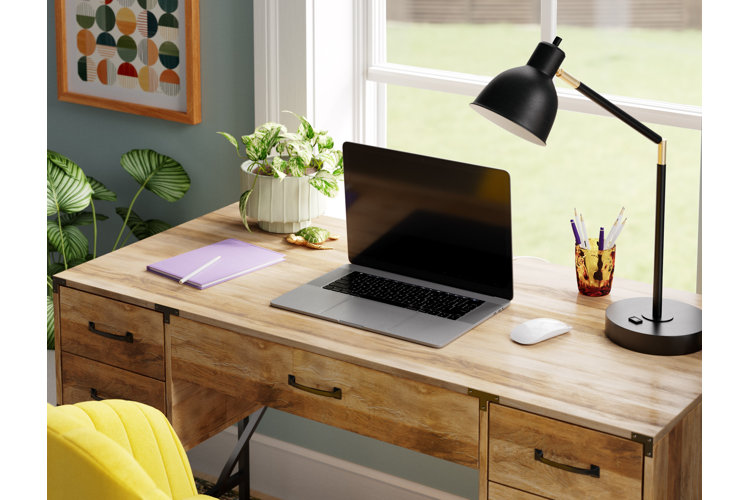
The desk width (or length) is the measurement that runs from left to right as you sit. The minimum length of a desk is 20", as this will typically accommodate a computer monitor. Review these desk width options and compare them to your space measurements to see what size will fit your space.
Small: If you have limited space, you might want to consider small desks. These are less than 40" wide and work well in dorms, apartments, and small rooms. Read our guide for more Small-Space Desk Ideas that'll make the most of compact corners.
Medium: Medium desks range between 40" and 60" wide. As the most common desk dimensions, these are ideal for almost all spaces and come in a wide range of styles.
Long/Large: The biggest of them all, long desks measure 60" wide and above. These are most commonly used in offices or in large spaces with ample room.
The depth of a desk measures from the front of the tabletop to the back. Choose the appropriate desk depth based on how much space you need to accommodate your equipment.
Narrow: Narrow desks are under 20" deep. These are great if you don't have too many devices and accessories.
Standard: Standard-depth desks are between 20" to 30" deep. These are great if you only need space for a laptop and monitor.
Deep: This type of desk is more than 30" deep. We recommend this depth if you have multiple monitors or need addtional room for file holders, letter holders, or other organizational tools.
Use the measurements of your office chair to help you pick the right desk height. Remember, the desk tabletop should rest 10" – 12" above the seat of your office chair to make sure there's plenty of clearance room for your legs. If your chair has armrests, you'll want the desk you choose to be at least 2" taller than the height of the armrests. This will make it easy to push your chair in after a hard day's work. Take a look at these common desk heights to determine the best option for you:
Short: These desks are under 30" tall. They are perfect for children.
Standard: The height for these desks is 30". This is the most common option for desk heights.
Tall: These desks are over 30" tall and are great for taller people. Most height-adjustable desks can be found in this range.
Tip!
Customize your workspace to your preferences by going with an adjustable-height desk!
In addition to finding the perfect desk height, width, and depth for your workspace, you also need to consider the impact that desk shape and design can have.
Leaning/Ladder: Leaning or ladder desks (pictured above) take up minimal space and have built-in shelves for vertical storage. This also allows you to keep the tabletop clutter-free while still being able to keep office supplies close by.
L-Shaped: L-shaped desks come in a variety of different lengths, but are usually better for larger office spaces or spacious corners. With this design, you get double the tabletop space, which is why L-shaped desks are so convenient. Corner-shaped desks are a great space-saving alternative for small office nooks.
Computer: Computer desks are usually deeper than traditional desks to allow plenty of space for multiple computer monitors, keyboards, and desktop storage. Compact computer desks have tiered platforms that take up less space while still allowing you to have two or more computer monitors.
Tip!
If you are looking for more information on types of desks and how to choose the right design for you, read our Desk Buying Guide.
Frequently Asked Questions
How tall is a desk?
Most desks are 28" – 30" tall so they can accommodate standard-size desk chairs.
What size desk is best for small rooms?
We recommend choosing a desk that is under 40" wide to suit small spaces.
What is the depth of a large desk?
Large desks often have a depth of 30" – 36".
