How to Find the Right Bed Size for Your Space
Measure up for comfort.

Choosing the right bed frame size starts with accurately measuring your room and planning your layout to ensure a perfect fit. In this guide, we’ll walk you through how to measure a bed to find the right one for your space.
In this guide:
1. Measure Your Bedroom
2. Consider Room Layout & Fixtures
3. Factor in Additional Furniture
Frequently Asked Questions
1. Measure Your Bedroom
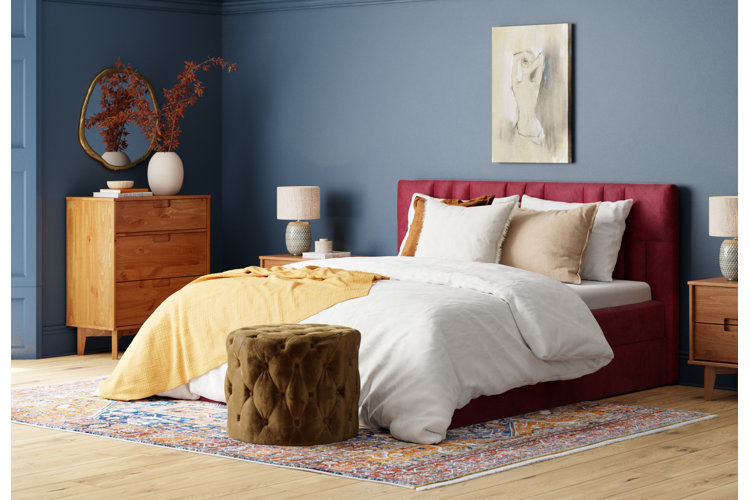
Before you begin, it's important to note that bed frames will typically add 2" – 5" to the length and width of your mattress. You have to consider how big the bed will be in total – not just the size of the mattress – to ensure it will fit in your room.
How to Measure Your Bedroom for a Bed
1. Measure the length and width of your bedroom using a tape measure.
2. Note the location of doors, windows, closets, and other architectural features.
3. Calculate the total floor area by multiplying length by width.
4. Determine your ideal bed size using the 1:3 bed-to-room ratio.
5. Verify that at least 2' of clearance remains on all accessible sides of the bed.
Choosing the right size bed depends on your available space. The bed-to-room ratio is the proportion of floor space your bed occupies; a 1:3 ratio means the bed should take up approximately one-third of your room's total floor area. For a well-balanced layout, there should ideally be a 1:3 bed-to-room ratio. However, this ratio can be unrealistic in small bedrooms.
Choose a Bed Based on Room Size
Here are the minimum room sizes required to comfortably accommodate each bed size:
- Twin: A twin bed frame is usually 77" – 80" long by 40" – 43" wide and will hold a 75" x 38" mattress. This bed needs at least a 10' x 7' room to fit comfortably.
- Twin XL: Twin XL beds are slightly longer than regular twins, measuring about 82" – 85" in length and 40" – 43" in width. These frames are built for 80" x 38" mattress and require 11' x 7' rooms.
- Full: At 77" – 80" long and 56" – 59" wide, full beds are wider than twins and can hold a 75" x 54" mattress. Place a full-size bed in a room that is at least 10' x 9'.
- Queen: Queen beds are 82" – 85" long by 62" – 65" wide and are suited for standard 80" x 60" mattresses. These beds fit well in 11' x 10' rooms.
- King: The next size up is a king bed measuring 82" – 85" in length by 78" – 81" in width, designed for an 80" x 76" mattress. A 12' x 12' room would best accommodate a king bed.
- California King: A California king bed frame will be 86" – 89" long by 74" – 77" wide and able to hold a 84" x 72" mattress. For a large bed like this, a 14' x 12' room is recommended.
Tip!
Also read Bed Buying 101: Types of Beds and What Are the Most Common Bed Sizes? to help you choose a bed that suits your style and sleeping requirements.
2. Consider Room Layout & Fixtures
Layout & Bed Placement
When measuring for a bed, factor in the space you need to maintain around it. Keep a minimum of 2' (or 24") of clearance on either side and at the foot of the bed to allow for easy maneuvering around the room. Ideally, you’ll leave 3' of space or more around your bed for a balanced layout. This is especially important for larger beds intended for two people. In these cases, the bed should be kept away from the wall to allow for easy access on both sides.
If you want to push the side of the bed against the wall, opt for a twin or twin XL bed that is designed for one person. When the side of the bed is against a wall, leave at least 2" of space to allow bedding to be tucked between the wall and the mattress. You may need more room if you have extra-plush bedding. This will also help simplify the process of remaking the bed.
Fixtures & Architectural Features
If you plan on positioning the side of your bed along a wall with windows, you’ll want to ensure that the bed sits below the height of the windowsill for privacy, aesthetics, and window treatment function. Bedroom windowsills are typically between 24" – 30" high, with the average bed height being around 24" (mattress included). To ensure a proper fit, measure the height of your bed frame (usually 13" – 15") plus the depth/thickness of your mattress (8" – 16"). The sum of these numbers should be less than the windowsill height.
Tip!
Also keep in mind the placement of any doors in the room. If the bedroom door swings inward, measure the arch of the door’s path to ensure it can swing open a minimum of 90° without being obstructed by the bed. If you plan on placing your bed directly across from the door, subtract the width of the door from the total length of the room to calculate the space you have for a bed.
3. Factor in Additional Furniture
While the bed is the focal point of a bedroom, you’ll want to leave room for other essential furniture fixtures. If you want to include nightstands, you may have to choose a smaller bed to leave space for them. You should strive to keep 2" – 6" of space between your bed and a nightstand. Assuming the average nightstand is between 21" – 28" wide, you’ll need an additional 23" – 34" of space next to the bed depending on the size of your table. For example, if you want to place a pair of 24" nightstands, you’ll need an additional 26" – 30" of clearance on either side of the bed to accommodate them.
It’s also common to place furniture like dressers and benches at the foot of the bed or directly across from it. On average, dressers are between 18" – 24" deep and benches are 15" – 18" deep. If you want to style a dresser or bench at the foot of your bed, add the length of your bed to the depth of the furniture piece. Subtract this sum from the length of the room, leaving a minimum difference of 24" – 48" for functionality and easy maneuvering. In the case of a dresser, double the depth of the piece before calculating the rest to ensure you can open the drawers fully.
Frequently Asked Questions
What is the minimum room size for a queen bed?
A queen bed fits well in a room that is at least 11' x 10'.
How much space should be around a bed for maneuvering?
Leave a minimum of 2' of clearance on either side and at the foot of the bed.
How do you ensure a bed fits beneath a windowsill?
Measure the bed frame and mattress height to ensure their sum is less than the windowsill height.
