How to Measure for a Stair Runner
Quick and easy steps.
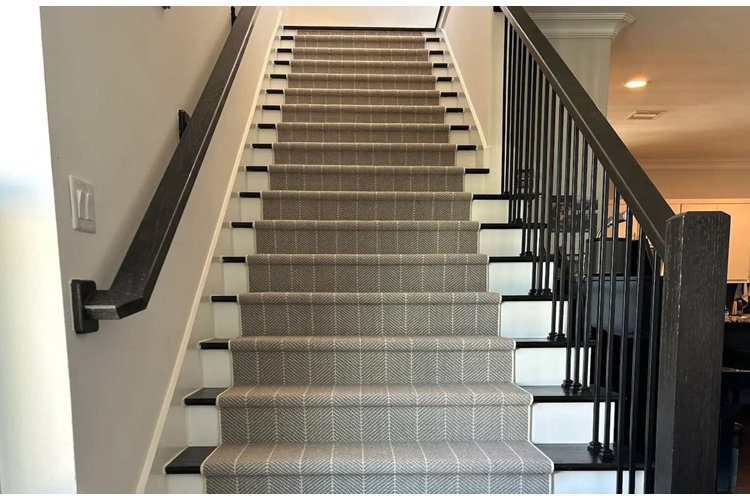
Stair runners give your stairs a customized, cozy look and add an element of safety by preventing instances of slipping. In this guide, we outline how to measure for them step-by-step and go over some common questions.
Skill Level: Beginner
Number of People: 1 Person
Time Length: 30 Minutes
What You'll Need:
- A tape measure
- A notepad & pencil
- Calculate or smartphone calculator
1. Measure the Stairs to Find the Proper Runner Length
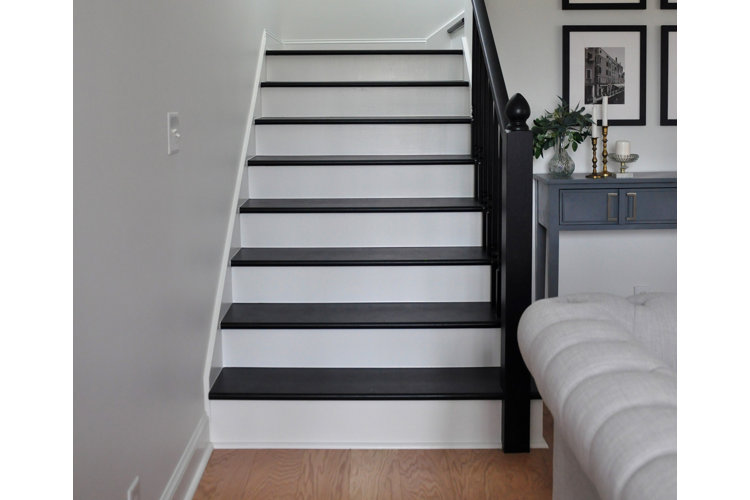
Determining the perfect runner length for your stairs is way easier than you might think. You just need to do a few measurements and calculations. For reference, in the image above, the "stair treads" are black and the "stair risers" are white.
1. First, count each stair tread (step) and each stair riser on your staircase.
Record the totals for each and double-check your work. The above staircase has eight stair treads (including the landing at the top if you have one) and eight stair risers.
2. Measure the depth of a single stair tread.
Place your tape measure on the edge of the step and measure to the spot where the tread meets the riser. Record the measurement in inches.
For the purpose of this example, let's say the stair tread depth is 10".
3. Next, measure the height of a single riser.
Place your tape measure at the spot where the tread meets the riser and measure upwards, allowing the tape measure to overlap with the edge of the next stair tread. Record the total height measurement in inches.
For this example, let's say the stair riser height is 7".
4. Multiply the tread depth by the total number of stair treads.
Now for some quick and easy math! You're going to multiple the tread depth by the total number of stair treads.
10" (depth) x 8 (stair treads) = 80"
5. Multiply the riser height by the total number of risers.
Multiply the riser height measurement you got by the total number of risers you counted on your staircase.
7" (height) x 8 (stair risers) = 56"
6. Add the results together.
This will be the minimum length of a stair runner for your stairs.
80" (total depth) + 56" (total height) = 136"
7. Then, add approximately 6" – 12" or more if there's a landing.
This is important because it ensures the rug length will cover your stairs. Any excess can just be cut off. If the first set of stairs attaches to a landing, make sure to measure the landing's total depth and use it instead of the 6" – 12" guidelines to help determine the proper runner length.
6" + 136" = 142"
If Accounting for Landing Depth:
(the total landing depth) + 136"
8. Convert the total measurement to feet.
Since most stair runners are measured in feet, you should convert 142" to feet to make the shopping process a breeze. You can either use an inches-to-feet converter online or complete the following calculation:
142"/12 = 11.8'
Round to the next highest number: 11.8' would round to 12'. So you want to make sure to shop for stair runners that are 12' long.
9. Repeat steps 1 to 8 if you have another set of stairs that's connected by a landing
Repeat this process if you have another set of stairs connected by a landing, as it will need its own stair runner.
2. Measure the Width of a Stair Tread to Determine the Best Runner Width
With the proper length figured out, let's figure out the best runner width. Typically, you want a 2" – 4" gap on each side of the runner for the stair tread to show through.
- To start, measure the total width of a stair tread from the railing to the wall or to the railing on the opposite side of the stairs (depending on your staircase design). This will be the total width of the stair tread.
- Then, subtract 4" – 8" from the total measurement.
- If you have narrow stairs, a 2" gap might work best, so you only need to subtract 4" from the total width measurement.
- If you have wider stairs, you might want to subtract 8" from the total width measurement, which means a 4" gap on both sides of the runner.
- The result is the ideal width of a stair runner to look proportionate to your stairs.
Example: The stair tread measures 42" wide in total. For a 2" gap on each side, you'll need to do 42" – 4" = 38", so you'll want to look for runners that are approximately 3' wide. For a 4" gap on each side, you'll need to do 42" – 8" = 34", so you'll want a runner that's just under 3' wide.
3. Account for Unique Landing Shapes
If you have a two-step winder landing like the one pictured above, all you need to do is add extra length to your runner measurements and then cut the runners to size.
- For example, you would complete the steps in step one like normal.
- However, you would then measure from the edge of the landing all the way to the wall, overlapping with the other triangular portion of the landing.
- Do the same for the top set of stairs, add the total length from the bottom stair across the triangular landing to the wall.
Then when you go to install the runners, all you have to do is cut each runner to the diagonal shape of the landing. Since the runners will be stapled down, they will still look like one seamless piece.
Tip!
Once you've completed your measurements and selected a proper size stair runner, you can get to installing! Check out: WATCH: How to Install a Stair Runner for a video demonstration, tools list, and step-by-step instructions.
Frequently Asked Questions:
What is the difference between stair runners and stair treads?
Stair runners are like hallway runner rugs since they come as one long piece. In contrast, stair tread rugs are sets of around 15 individual mats that are proportioned to fit the length and width of each individual stair tread. Stair runners offer a more cohesive look because the fabric covers the risers and the treads of the stairs, while stair tread rugs only cover each step – not the riser portion. This typically makes stair tread rugs more easy to measure for and install, but they don't offer the same stylistic look as stair runners. It's all up to your preferences!
Can you put a stair runner on a curved staircase?
Yes! You just have to take additional measurements where the stairs curve so you can cut and install that portion of the stair runner to size. We recommend going with a stair runner that's much longer than the actual length of your stairs so you can accommodate for curves and have enough that if you need to cut the stair runner there is still plenty to work with.
Tip!
Review Home Improvement 101: Simple Staircase Renovation for more ways to upgrade your stairs.
