How to Measure for Wallpaper
Find all the handy calculations you need.
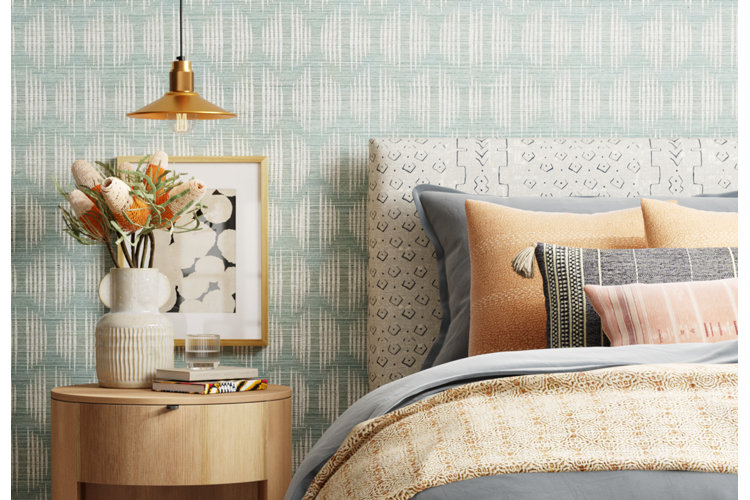
Wallpapering your home is a fun DIY project that adds texture and elegance to any space. Wondering just how much wallpaper you’ll need to get the job done? Keep reading for a few basic measurements and calculations to cover your walls with seamless style.
What You’ll Need
- Dimensions of a wallpaper roll
- Tape measure
- Paper & pencil
- Calculator
- Step ladder
Step 1: Measure the Area of Your Walls
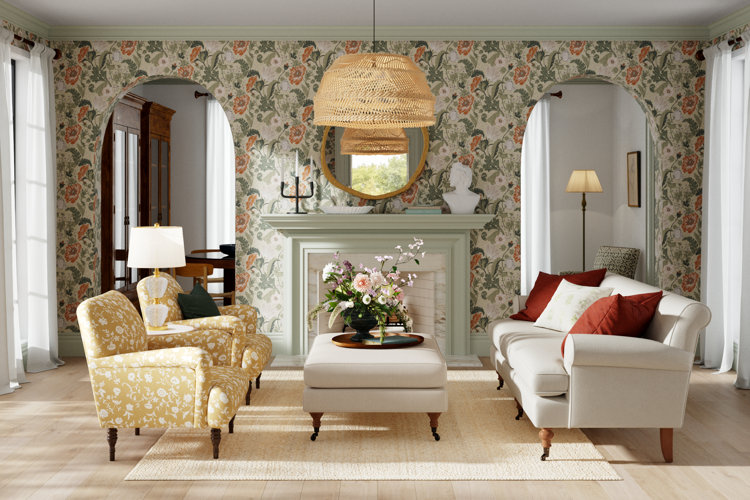
To find out how many wallpaper strips you'll need to cover your walls, begin by measuring the total area of wall space in the room. Jot down all of your measurements as you go for easy reference while you shop.
1. Measure the Wall Widths
Measure the width of each wall from left to right. Then, add these numbers together to get your total width.
2. Measure the Wall Heights
Get out your step ladder and measure the height of each wall from baseboard to crown molding. If your walls have different heights (e.g., if you have a vaulted ceiling or a sunken living room), measure to the highest point at which the wall meets the ceiling.
3. Calculate the Total Area
Multiply the height of your ceiling by the total width of your walls to find the area of wall space you need to cover. If you measured the walls in inches, divide this number by 12 to get the area in square footage. This will make purchasing wallpaper easier.
4. Account for Large Cutouts
Measure the area of any cutouts including windows, doors, cabinets, and fireplaces. If the total area of these cutouts is less than 20 square feet, don’t subtract it for your total area. When in doubt, opt for more wallpaper to be safe. Extra paper will act as a budder for mistakes.
Sample Room Measurements:
- Width of each wall: 11'
- Number of walls: 4
- Total Width: 11' x 4 = 44'
- Wall Height: 8'
- Total Area: 44' x 8' = 352 sq. ft.
Step 2: Choose Your Wallpaper

Now that you know the total height and width of the walls you plan to cover, choose a wallpaper pattern you love and take note of its dimensions. Specifically look for the length and width of the wallpaper roll, as well as the design repeat measurements which tells you the distance between each repeating pattern.
Sample Wallpaper Measurements:
- Roll width: 30" (2.5')
- Roll length: 33'
- Design repeat: 36" (3')
You can either use the total square footage of your wall space or the individual wall lengths and heights to determine how much wallpaper you’ll need. If the wallpaper you choose has a 0" pattern repeat, proceed using the total square footage measure. For wallpaper with complex, offset patterns, use the following formula:
1. Determine the Number of Strips Needed
Divide the total width of your walls by the wallpaper's width. This number will tell you how many floor-to-ceiling wallpaper strips you need. (Ex: 44' / 2.5' = 17.6 strips needed).
2. Find the Adjusted Height
Add the height of your walls to the pattern repeat length to get your adjusted height. Wallpaper with a repeating design needs to be aligned at each seam, which often requires trimming excess paper. Adding the pattern repeat to your wall height ensures each strip is long enough to correctly match the design from top to bottom. (Ex: 8' + 3' = 11' adjusted height).
3. Calculate the Useable Strips per Roll
Divide the length of the wallpaper roll by the adjusted height to find out how many full strips you can get from each roll. If your result is a decimal, round down to the nearest whole strip. (Ex: 33' / 11' = 3 usable strips per roll).
4. Determine How Many Rolls You Need
Divide the total number of strips you need by the number of usable strips per roll. If this number ends in a decimal, round up to the nearest whole roll. (Ex: 17.6 ÷ 3 = 5.87 rolls, rounds up to 6 rolls). As a final safety measure, add an extra roll to your final calculation to account for mistakes or future touch-ups.
Tip!
Read our guide on Wallpapering 101: How to Install Wallpaper for everything you need to know after determining how much wallpaper you need.
