Murphy Bed Sizes & How to Pick the Right One for You
Murphy bed dimensions and what they mean.

Living in a small space means that every inch is premium real estate that you don't want to waste. Of course beds are one of the main culprits with the largest footprint, but what if there was a way to free up that floor area when you aren't sleeping? Murphy beds are the answer! These compact cabinet or wall beds are just that – they are literally attached to the wall and fold down out of a cabinet or doors, to create a fully functional (and comfortable) bed. And when you are done, you simply lift and tuck it back up to open up your floor again. Whether you live in a small city apartment, loft, or even a dorm room, or are looking for a space-saving sleeping solution – Murphy beds are the answer. So maximize your home and learn about the different Murphy bed sizes so you can pick the right one for your needs!
Tip!
To learn more about Murphy beds, read our guide What Is a Murphy Bed? How to Buy the Best Murphy Bed for Your Space.
Murphy Bed Sizes & Where They Work Best
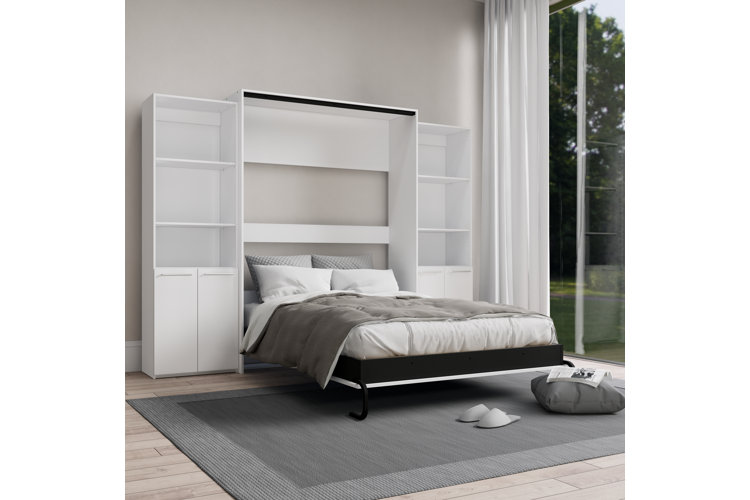
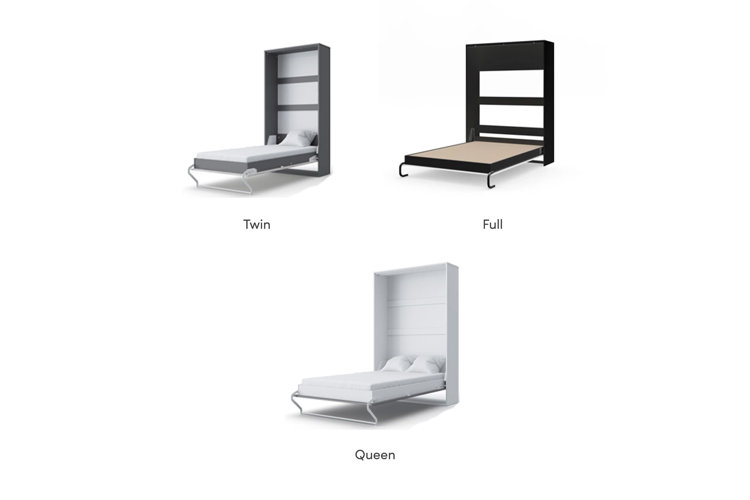
The most common type of Murphy bed you will find is the vertical style, which folds out of the wall at the top (which is connected to the wall) and uses a pivot to bring the rest of the bed down. Just like regular beds and mattresses, there are a few Murphy bed sizes to choose from ranging from twin to queen. Purchasing and installing a Murphy bed requires care, so you want to ensure you choose the correct size for your needs.
Tip!
While it is possible to find horizontal Murphy beds that attach via a single side, these are less common than their vertical counterparts.
Murphy Bed Dimensions
In order for your Murphy bed to work, you must ensure the ceiling is high enough to accommodate the wall cabinet and bed when in the upright position and that it is a suitable distance from fans and light fixtures while folding and unfolding. You'll also need to account for the distance it projects into your room.
Below are the different murphy bed measurements and the locations and situations they are most suited to.
Murphy Bed Measurements Terminology
- Height – the ceiling should be at least 2 1/2 inches taller than the closed bed cabinet.
- Width is measured from the outer sides of the cabinets holding the bed.
- Depth starts from the wall all the way to the front face of the bed when in the closed position.
- Projection is the dimension from the wall to the outside of the bed frame when in the open position.
Murphy Bed Dimensions
Twin: These are best used in small kid's rooms, dorms, or sleeping spaces that are too small to accommodate anything larger. The twin Murphy bed dimensions are typically as follows:
- Height: 82 – 87 inches
- Width: 43 – 46 inches
- Depth: 18 – 21 inches
- Projection: 80 – 82 inches
Full: A full Murphy bed is ideal for guest rooms or smaller rooms where you aren't able to fit a queen bed. They are slightly larger than the twin and provide a comfortable sleeping area for two but still saves space when not in use. Their dimensions are:
- Height: 82 – 87 inches
- Width: 57 – 61 inches
- Depth: 18 – 21 inches
- Projection: 85 – 87 inches.
Queen: The largest of them all, queen Murphy beds allow for two adults to sleep comfortably. They are ideal in guest rooms, apartments, home offices, and anywhere else you have space to spare. They are the most popular option with these dimensions:
- Height: 87 – 89 inches
- Width: 64 – 68 inches
- Depth: 18 – 21 inches
- Projection: 85 – 87 inches
Murphy Bed Extras
Along with these more standard Murphy bed measurements, it is also possible to find models with extra features or dimensions.
Tall Clearance: This option is for those who want a Murphy bed that has a large clearance (typically for storing items or furniture beneath when the bed is down).
Low Height: If you have mobility issues or are looking for a Murphy bed that sits closer to the ground, you will want a low design.
Standard: The most common Murphy bed height is the standard, which you can select if these measurements meet your specific criteria and requirements.
Tall: Ideal for anyone who prefers to sleep higher off the ground or needs a taller base to more easily get onto the bed.
Extra Storage: Many Murphy beds also feature additional storage, often found in the form of shelves or cabinets on either side of the mattress or above where the headboard would go.
Headboard: It's also possible to get Murphy beds with headboards. Some will offer extra storage and others will have features like charging ports or lights.
The purpose of a Murphy bed is to save space, making it essential to calculate the area you intend to install yours in for a proper fit. When you measure the space you will need to consider the height, width, and depth when closed, as well as the projection (distance from the wall to the edge of the bed frame).
*Note these measurements are all for vertical Murphy beds.
Step 1: Use a tape measure to get the width of the wall space you will be installing your Murphy bed on. Ideally it should be no less than 47 inches wide.
Step 2: Then measure the vertical space from the floor to the ceiling. A minimum height of 82 inches is best.
Step 3: Finally measure from the wall area to where the Murphy bed will extend to when it is opened. This projection length should be a minimum of 85.25 inches.
Step 4: You will need around 30 – 36 inches on either side of the bed for comfortable use. This is also helpful if you intend to add cabinets for storage or nightstands.
Once you have these measurements you can determine what Murphy bed size will be most suited to the space as well as your needs.
Tip!
A Murphy bed must be mounted to the wall studs (at least three, but four is best) and because they use things like gas pistons for the leverage, it is imperative to correctly assemble and install the cabinet for your safety.
How to Choose a Mattress for Your Murphy Bed
Once you have taken your Murphy bed measurements and have found the right bed size, you can move on to selecting the correct mattress. While there are some mattress included options, it is more common to purchase yours separately.
Most Murphy beds are designed for mattresses around 12 inches thick, and considering the fact that the majority of mattresses measure between 10 – 12 inches, it's fairly simple to find the right size. For a few guides on the best mattresses and mattress firmness, read The Best Mattresses for a Sound Sleep and Your Guide to the Mattress Firmness Scale.
An important thing to know is that the upright position of the Murphy bed can place pressure on the mattress and cause slumping in innerspring and hybrid mattresses as the coil springs weigh more, leading to extra pressure at one end. For this reason, the best mattress options are memory foam and latex.
Once you have the right measurements and know which of the Murphy bed sizes is right for your space. You will be able to purchase yours with ease, ensuring it will fit correctly and sleep well
You Might Also Like:
