How to Choose a Blender
Ensure you pick the best one.
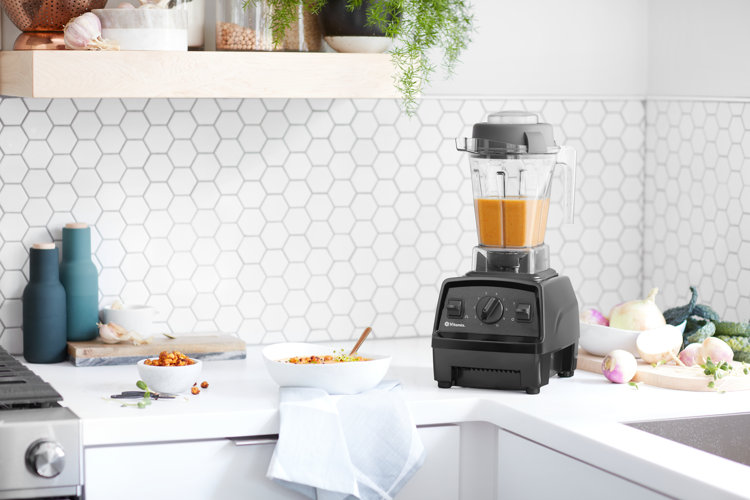
The right blender should be the perfect size for your household and fulfill your needs – whether it's smoothie-making, sauce-making, or creating your own nut butter. Follow these steps to find your perfect blender.
1. Consider the Best Size Capacity
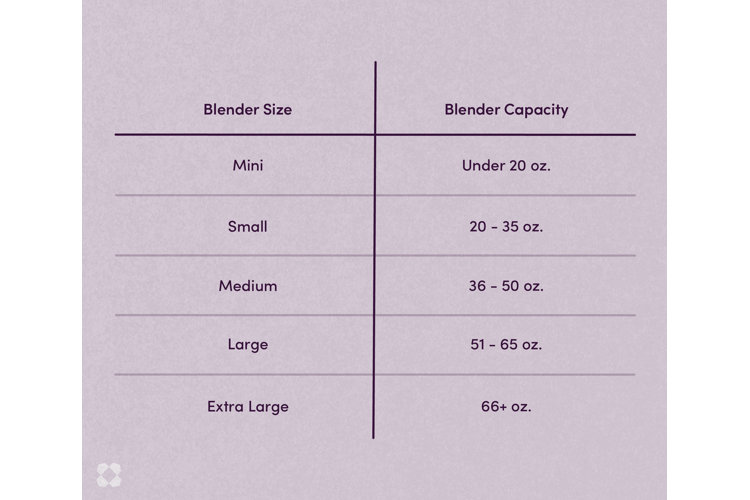
Blender capacity, usually measured in ounces, describes how much material a blender can hold. This metric only applies to blenders with enclosed jars, not hand immersion blenders that can be placed in containers of many sizes. Use this chart and the information below to figure out which size works best for you:
Mini: These blenders can satisfy the needs of one person since they hold under 20 oz., and are usually categorized as personal or portable blenders.
Small: Small blenders are typically personal, portable, or small countertop blenders and can satisfy the needs of two people. They hold 20–35 oz.
Medium: These are countertop blenders that hold 36–50 oz. and can satisfy the smoothie-making needs of up to four people.
Large: Large blenders are designed to feed up to six people since they hold between 51–65 oz. of ingredients at a time.
Extra-Large: Extra-large 66 oz.+ blenders work best for large families or those who frequently host since they can feed up to eight people.
Tip!
Never fill a blender all the way to the top! It won't function properly without a little extra space. Keep beneath the engraved capacity line, or try to keep below three-quarters full. If you're worried about fitting your ingredients, go up a blender size.
2. Next, Choose a Blender Type
There are five categories of blenders that each offer their own features and benefits. Explore each option, below:
Countertop Blenders
Countertop blenders are versatile machines used for mixing drinks, pureeing fresh foods, and chopping ice. They typically include a jar and lid, blade assembly, and a base with controls. Countertop blender jars are typically made from materials like glass, plastic, or stainless steel. In some cases, the blade assembly is affixed to the jar and cannot be removed, while other blade assemblies are removable for cleaning. The base of the blender will vary in style and design but traditionally comes with a number of speed settings and a pulse button or lever. These blenders may also come with a tamper or stirring stick to help push food down to the blades.
Traditional countertop blenders are great for simple smoothies with liquid, fresh fruit, and even a little ice. You can also blend milkshakes (to learn how, read our guide, How to Make a Milkshake with a Blender). If you enjoy making your own salad dressings or marinades, a traditional countertop blender can usually do the job, depending on the ingredients.
High-speed blenders are countertop blenders designed to handle tougher ingredients and have the ability to produce a smoother blend. Like traditional countertop blenders, they consist of a jar, blade, and base, but with differences in each. The jar is typically made from a thick plastic rather than glass. Blade assemblies range from two extremely thick, dull blades to six razor-sharp ones. This blade design is necessary in order to liquefy dense ingredients, to crush large quantities of frozen food and ice, and to make thicker recipes like almond butter and hummus.
High-speed countertop blenders are great for smoothies with liquids, fresh or frozen fruit, ice, and even your favorite greens. They also work well for whole juices, batters, baby food, ice cream, soups, and more. There really is not much a high-speed blender can't blend.
A personal blender is a mini blender meant for single servings of smoothies and smaller batches of sauces and dressings. Typically, a personal blender's jar is an upside-down cup that screws onto the blade assembly and the base. In many cases, the blender cup can also be used for serving. Some personal blenders come with caps that fit onto the blender cup, making them portable and great for an on-the-go lifestyle. Often, different sized blender cups are included with personal blenders as well.
Personal blenders are an extra-efficient, easy-to-clean, and small space–friendly alternative to the traditional countertop blender. However, because of the blades' smaller size, you might find yourself needing to cut fruits, vegetables, and other materials into smaller pieces to blend efficiently. If you're a smoothie devotee without a lot of time on your hands in the morning, the personal blender is the one for you.
Ever wish you could make a fresh smoothie or protein drink at the office, at the gym, or while traveling? Portable blenders were designed just for these instances! They're similar to personal blenders in design, but instead of being plug-in, they're typically battery-powered. However, some newer models are chargeable. The other difference is that the blender cap is actually the lid from which you drink out of and add ingredients.
Also known as immersion blenders, hand blenders are long, stick-like appliances with rotating blades at the bottom end. To use, place the blade end into the material you want to blend and press the blend button. Immersion blenders are best suited for making soups and sauces out of hot materials, but they can handle smoothies and milkshakes as well. Because they aren't connected to the container holding the blending material, hand immersion blenders are a cinch to clean at any point while preparing food. Some even have more than one blender attachment (like a whisk) to add some functionality beyond chopping. There are even cordless hand immersion blenders, which adds another level of convenience. Learn more in our guide on What Is an Immersion Blender? (And How It Will Make Your Life Easier).
When buying a blender, wattage is important to consider. Wattage describes how powerful a blender's motor is. The higher the wattage, the more powerful the motor, and thus the more powerful and effective the blender.
Standard Power: These blenders are up to 500 watts and are best suited for blending liquids or soft fruits.
High Power: High power blenders are 500–1000 watts, making them powerful enough to blend frozen fruit and crush ice.
Professional Power: Professional power blenders are above 1000 watts and can perform more advanced functions like grinding ingredients or making nut butters.
Tip!
It's important to note that the type and size of the blender doesn't usually impact the wattage, so there can be personal-size blenders that are high power or countertop blenders that are standard power and so on.
4. Check Out Must-Have Features
Once you have an idea of the capacity, blender design, and wattage you want, you can start looking into additional features. These range from specific blending functions to cleaning features and helpful add-ons.
Smoothie: Opt for a blender specifically designed to make smoothies to ensure it delivers quality-tasting smoothies with well-blended ingredients.
Hot Soup or Drink: There are a wide range of countertop, personal, and hand-immersion blenders that are specifically designed to puree hot ingredients. These blenders are typically made with high quality glass that won't break with intense heat exposure.
Peanut Butter Maker: Some modern blenders have the blending power to make nut butter. If you're interested in making your own peanut butter or other nut butters, filter your search to include blenders with this specific feature.
Pulse Function: A blender with a pulse function gives you more control over the blending process, as blending will only occur when you are holding the pulse button and will stop when you release it. This is especially useful for chopping vegetables and fruits without completely pureeing them.
Ice-Crushing: Not all blenders can effectively and efficiently crush ice. If this function is important to you, narrow your search to include blenders with ice-crushing capabilities.
Self-Cleaning: With a little dish detergent and water, a self-cleaning blender can blend away all leftover debris, even bits left in the lid!
Multiple Attachments: Be on the lookout for blenders that come with more than one blender attachment, like different sized blades, extra serving cups, whisk attachments, or even food processor jars to optimize your experience.
