The No-Sweat Guide to Air Conditioner Types
From air conditioner types to air conditioner sizes, we break down all your options.
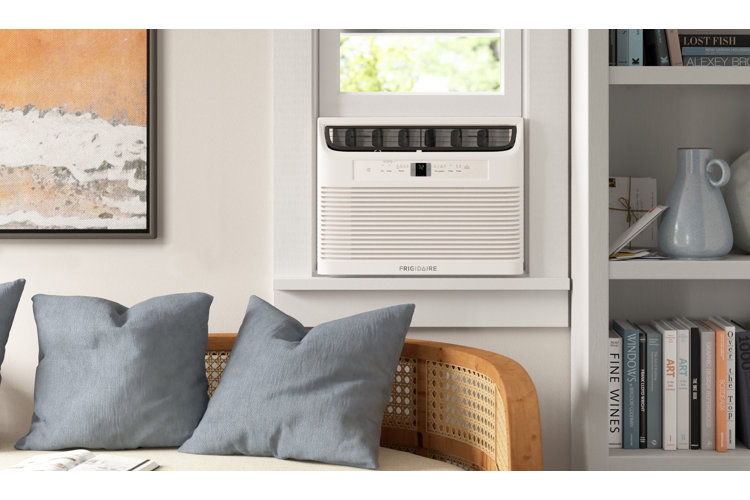
Whether you need a temporary fix for the warmer months or a permanent, year-round solution, buying an air conditioner doesn't have to be daunting. To find one that's right for you and your space, take a look at the top air conditioner types and features outlined in this guide. Read on to find the right air conditioner to fit your cooling needs, or skip ahead to that section to learn what size you should buy or how many BTUs will be needed to cool your space.
Types of Air Conditioners
Air Conditioner Sizes and Specs
Additional Features to Consider
Types of Air Conditioners
When shopping for an air conditioner, it's important to consider the space you're cooling and the type of installation that works best for your home. Some air conditioners are ideal for seasonal cooling while other models are designed for year-round use. With five main types of air conditioners to choose from, it's easy to find a unit that suits your home. We've outlined the different types below to help you choose the right one.
1. Window: Easiest to Install
2. Portable: Can go in any room with a window
3. Ductless Split-Wall: Can cool multiple rooms at a time
4. Through-the-Wall: Can double as a heater in the winter
5. Evaporative Cooler: Energy-efficient and great for hot, dry climates
1. Window
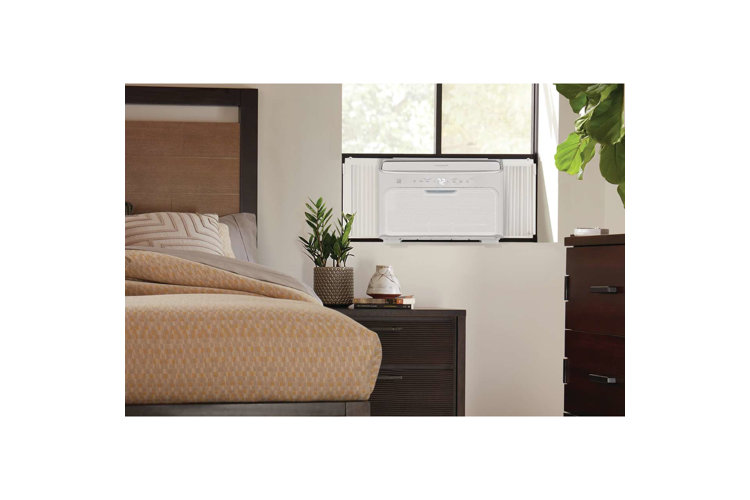
This style mounts in a standard window frame with a cool-air fan facing inward. Designed to cool a single room, window units are ideal for bedrooms and small living spaces. Multiple window units can also be installed in larger windows to provide ample cooling power. These air conditioner types are easy to install – most plug into standard wall outlets. Though installation is temporary, these units are meant to fit snugly in the window. As a result, they may partially obstruct the view from the window.
Placement & Installation
Before choosing a window unit, we recommend measuring your window to make sure you pick the right size. The window where you plan on installing the unit should be near an outlet and not one of your emergency exit points. This type of air conditioner is placed on the windowsill and secured by closing the window above or around it. Most window units include side brackets that attach the wings of the appliance to the window sill to create a tight seal. Additional exterior brackets can also be added for extra support and security.
Pros & Cons
Pros: Window air conditioners are affordable and can be easily installed in any window. This flexible quality is ideal for cooling your home during the warmer months and storing the unit when not in use.
Cons: Because window units are often designed for temporary use, they aren't the best option for long-term cooling. Window air conditioners also take up valuable window space and are more prone to creating drafts.
Overall, this type of air conditioner is a great short-term solution for cooling your home quickly with super easy installation.
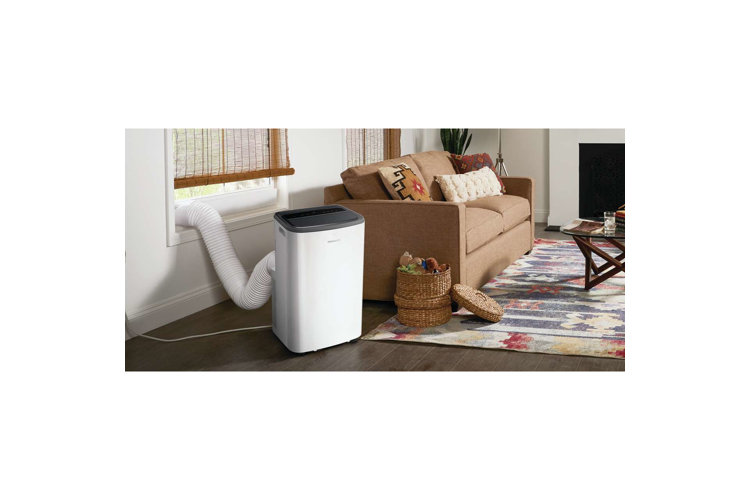
Also designed to cool a single space, these compact units can be moved from room to room, but must vent through an exhaust hose out a window. These types of air conditioners come with exhaust systems that are easy to install and remove. They're ideal for windows of a nonstandard size or for buildings where window units are prohibited.
Placement & Installation
Because portable units use a hose to draw in fresh air and expel exhaust, they need to be placed near a window and in a spot that allows the hose to stretch without any obstacles. Portable air conditioners require minimal installation – window installation kits include all necessary components, such as foam strips for sealing, window brackets that sit on the sill and connect the exhaust hose, and mounting hardware.
Pros & Cons
Pros: Portable air conditioners are an excellent alternative to window-mounted or through-the-wall units if your space doesn't have standard-sized windows or if you live in a building that doesn't permit window units. Portable air conditioners have a compact design that features wheels so that you can move the unit from one room to another.
Cons: Portable air conditioners take up floor space and are often less effective at cooling large rooms than other types.
Though these portable units take up floor space, portable air conditioners are easy to set up and don't require permanent installation.
These air conditioner types are permanently installed and connected to an outdoor compressor for a whole home air treatment solution. Ductless split-wall air conditioning systems can consist of multiple air cooling units connected to the same compressor, so they can cool multiple rooms in your home at once.
Placement & Installation
Ductless split-wall units are connected to an outdoor compressor and must be installed on the interior side of exterior walls. They should also be placed at least 6' high and out of direct sunlight. The outdoor compressor can be placed on the ground, rooftop, or the exterior side of the wall. The unit and the compressor are connected by pipes and tubing, so the outdoor unit needs to be close to the indoor unit. Since installation requires drilling, hardwiring, and handling refrigerant, we recommend hiring a professional to install this type of air conditioner.
Pros & Cons
Pros: They're small in size and incredibly energy-efficient. Though they take more work to install, ductless split-wall air conditioners only require a small hole where the indoor component is attached to the pipes that connect to the compressor. Some models can connect up to four air conditioners to one compressor, so you can cool different rooms in your home with separate thermostats to control each zone.
Cons: Ductless split-wall models take more work to install than a window or portable unit and can cost more than other types of air conditioners.
In total, ductless split-wall air conditioners offer long-term cooling and the ability to cool different areas of your home.
These units are installed permanently in an exterior wall and require a wall sleeve to support their weight. Through-the-wall models have higher cooling capacities than typical window units. Because these units are permanently installed, these appliances can often double as heating units in the colder months.
Placement & Installation
Through-the-wall units should be installed near an outlet and away from any furniture that could obstruct the flow of cool air. They should also be placed 1'–5' off the ground to minimize the amount of dust that could collect in the air filter. These air conditioners often require cutting through exterior walls, so we recommend hiring a professional to install the units securely. To install this type of unit, you'll need caulk, saw, drill, drywall, a stud finder, and a sleeve or bracket.
Pros & Cons
Pros: This type of air conditioner is installed through an exterior wall and doesn't take up any window space. The snug installation also minimizes air leaking out around the unit, which helps cool your home more efficiently. Through-the-wall units can be easily replaced and fitted inside the existing sleeve. Most through-the-wall air conditioners are standard-sized to make the replacement process simple.
Cons: Through-the-wall units are installed permanently, so they might not be the best choice for all-weather climates unless you opt for a unit that doubles as a heater.
If you're looking for a permanent installation, through-the-wall air conditioners are a highly-efficient option.
Unlike conventional air conditioners, evaporative coolers use water evaporation to lower room temperature. This process is highly effective at cooling, as well as much more energy-efficient than the refrigerative cooling performed by other air conditioners. They are best suited for regions with hot and dry climates, like the climate of regions between the Rocky Mountains and the West Coast. Read our guide What Is an Evaporative Cooler? Learn Why It’s Right for Your Home for more information on how evaporative coolers work, different types of evaporative coolers, and tips for maintenance.
Placement & Installation
Like portable air conditioners, evaporative coolers must have access to fresh air through a window. Evaporative coolers come in portable, wall-mounted, and ground-mounted designs to accommodate your space. With each location, evaporative coolers require a constant flow of fresh air so that the unit doesn't recirculate the air it had already cooled.
Pros & Cons
Pros: Evaporative coolers can cool a room quickly and efficiently while using less energy than traditional air conditioners. This makes evaporative coolers a more eco-friendly option that keeps your energy bills low.
Cons: Because evaporative coolers use evaporation to create a cooling effect by adding moisture to the air, they cool most effectively in hot, dry climates. If you live in a humid environment, evaporative coolers are not the best choice for your home. These units also consume a lot of water – 4–10 gallons per hour – and need to be refilled frequently during hotter months, so they may not be optimal for all households. Their water reservoirs need to be manually refilled when empty.
Overall, evaporative coolers are a great way to cool your home if you live in a dry climate.
Air Conditioner Sizes and Specs
To ensure that you choose the air conditioner that's right for you and your needs, make sure you know the specifications outlined below.
Room Square Footage: Measure the length and width of your room, then multiply the dimensions to get the total square footage. Refer to this number when determining cooling capacity. Using an air conditioner that’s too small or that has inadequate cooling capacity can sometimes increase your energy costs because the units have to run more frequently.
Window Size: If you're looking for a window or portable unit, measure the windowsill and window opening to determine what size unit you need.
Voltage: Most air conditioning units are designated as either 110 – 120V or 220 – 240V, which indicates the voltage required for operation. Check the product description for the voltage required. A 110–120V air conditioner plugs into a standard household outlet. Anything higher is more powerful and requires a specialized outlet that must be professionally installed.
Cooling Capacity: An air conditioner's cooling power is measured in BTUs (British thermal units), which can range between 5,000–34,000 BTUs per hour. The higher the BTUs, the greater the cooling capacity. Use the chart below to determine the recommended BTUs for your room size. If the unit will be in a sunny room, busy kitchen, or room with high ceilings, you may want to round up to a higher BTU.
You might be wondering, how many BTUs do I need? We've compiled a chart of recommended BTUs based on square footage.
Tip!
Shop air conditioners by room size; they are available in small room sizes (100 – 300 sq. ft.), medium room sizes (300 – 600 sq. ft.) and large room sizes (over 600 sq. ft.). Not sure which size is best for your space? Review What Size Air Conditioner Do I Need? To browse with confidence.
Additional Features to Consider
Now that you have a good idea of your air conditioner options, it's time to decide which features you can't live without. These features make it easier for you to control and monitor the temperature of your air conditioner unit and aid your experience and your energy goals.
Remote Control: Control the temperature or fan speed of your air conditioner from across the room with a remote control feature.
Programmable Timer: The air conditioner will turn on or off depending on the time of day. This is especially helpful for cooling down a room before you get home.
Thermostat: Air conditioners with thermostats help you manage the temperature inside your home. The thermostat allows you to adjust the settings for a specific temperature, which makes it easy to adjust the temperature of your home to match your preferences.
Heater-Included: Heat and cool your home with an air conditioner that includes a heater. These air conditioners are designed to effectively heat your space by reversing the cooling function to fill the room with warm air instead of cool air. Though the heater provides ample warmth, this feature is best suited as a supplement to your main indoor heating system.
Wi-Fi-Connected: Wi-Fi-connected air conditioners allow you to adjust the settings from your smartphone. This feature gives you the ability to customize the settings, add programmable timers, and turn the air conditioner on and off remotely.
Energy-Efficient: Each unit will provide their Energy Efficiency Ratio (EER) which measures the amount of energy a unit requires to deliver a certain amount of cooling. The higher the EER, the lower the energy use (and the smaller your electric bill). Look for units with the Energy Star label, as they use less energy, are environmentally friendly, and meet the standards set by the U.S. Environmental Protection Agency and the U.S. Department of Energy.
Decibels: Make sure you're looking for air conditioners that won't disturb your household too much. Air conditioners are available at under 40 dB (below library sound level), between 40 and 50 dB (below conversation sound level), between 50 and 60 dB (below restaurant sound level), and between 60 and 70 dB (below vacuum level).
Stay cool by browsing our selection, now!
