Outdoor Lighting Guide
Light up the night.
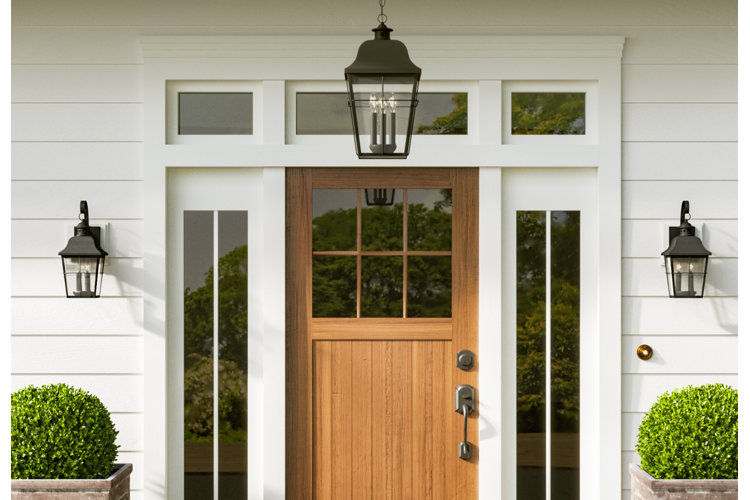
Outdoor lighting comes in many shapes and sizes, making it easy to highlight your home's architecture, create a safe atmosphere, and add ambience to your patio or garden. Our outdoor lighting guide will help you find the best way to light up your home’s exterior.
1. Choose a Type of Outdoor Lighting
Hanging Ceiling Lights
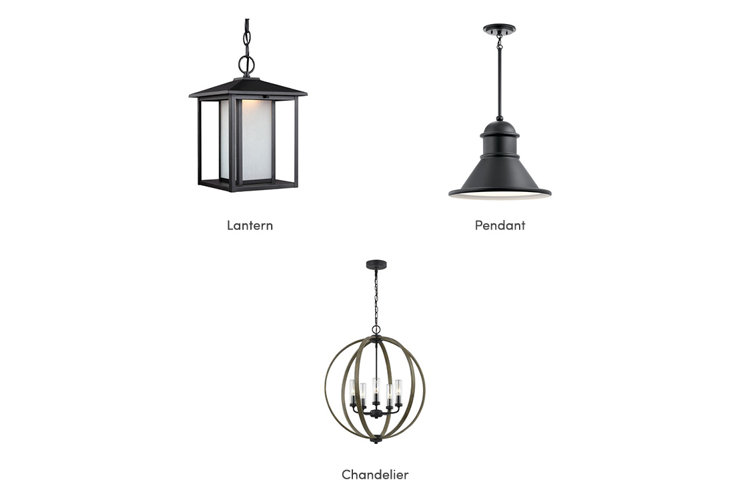
Hanging lights can be adjusted and are ideal for covered porches with a high ceiling. If you choose a hanging light, we recommend having the bottom at least 6' – 6½' above the floor to ensure that you can pass under it without bumping your head.
Flush mounts are installed directly to the ceiling of a porch or entryway overhang, making this type of lighting great for low ceilings. Semi-flush mounts are similar but have a short downrod that extends from the ceiling, providing a more decorative touch.
Wall mounts come in a variety of styles and can be hung on each side of the door, providing ample light. With various styles available, find the one that complements your home.
These lights often sit on top of stakes or posts that stick into the ground along a path, but they also include deck lights, step lights, and fence post cap lights. Landscape lighting can be solar-powered, hardwired, or battery-operated. They are best used to highlight areas of your outdoor space such as your garden, lawn, deck, or specific landscape elements. They can also illuminate the pathway leading to your door. Choose a landscape lighting kit to ensure all the lights have the same style.
These mount on top of posts or poles and can be placed anywhere. They provide ambient light, so they work well when placed along driveways, pathways, or on the edge of patios. Post lighting either mounts on top of an existing pillar or comes attached to a pole. The post should be secured about 1½' to 2' below the ground, the light fixture should be ¼ the height of the exposed pole, and the exposed pole should be 5½' to 6½' tall.
String lights come in various forms. Most commonly, they are small lightbulbs placed along a cord. They can be exposed bulbs, covered with a design, or lantern style. Fairy string lights are also growing in popularity – these have micro lights placed along a metallic wire, resembling fireflies. These are perfect to add some magic to any deck, patio, or yard. String lights are great for renters, as they are removable and don't require intricate installation.
Security lighting includes motion sensor lights, flood lights, spot lights, LED-security lights, and wall pack lights. They are best used to provide extra security by illuminating the dark areas of your property. Most flood and spot lights also have a motion sensor, so they will turn on when they sense movement. They turn off again after a certain period of time if they don’t sense movement. This feature is meant to reduce criminal activity and make the space safer – all meant to give you peace of mind. These lights are great for back decks, front porches, and above garage doors.
Portable and decorative, outdoor lanterns are often placed in the middle of tables or seating areas and provide a soft glow and ambience to the space. They are often filled with real or battery-operated candles. You can also fill them with battery-operated fairy string lights for a whimsical touch. Outdoor lanterns are great for renters, as they are portable and barely require installation.
In addition to the types of outdoor lights, there are extra features to consider. These convenient features can help with improving your home's security and cutting down on energy costs.
Solar-Powered: Solar lights draw energy from the sun, so they need to be placed in areas that receive plenty of sunlight. However, if it's cloudy out during the day, a solar light will not give off as much light at night. Solar-powered lights are easy to install since they do not need an outlet or hardwire. They often use LED lightbulbs for even more efficiency. Solar lighting is great for renters as they don't require intricate installation.
Dusk to Dawn : These lights detect natural light, turning on after sunset and turning off when the sun rises. These help save energy so you aren't keeping the lights on all day.
When choosing lights that will be outdoors, the damp/wet rating is a key consideration. This rating will tell you which locations are safe to place these lights. For example, a damp-rated fixture can't be placed in all of the same spots as a wet-rated fixture.
Damp Location: Damp location lights can be exposed to periodic moisture, but cannot be exposed to water, rain, or snow. They must be placed in fully covered locations, such as a covered patio or porch.
Wet Location: Wet location lights can be directly exposed to moisture, water, ice, and snow. They can be placed on open-air decks, patios, walkways, and exterior walls.
Dark Sky Compliant
The International Dark-Sky Association is dedicated to reducing light pollution and the negative effects light has on nature. It also wants to cut down on the amount of energy used. Lightbulbs that are dark sky compliant have a warm glow and do not emit blue light, which can be harmful to wildlife. Compliant light fixtures are hooded or shielded and direct the light downward.
Entryway: Best for your front steps, porch, and door, entryway lighting should be soft and welcoming. We recommend wall mounts on either side of your front and back doors, a hanging light on your covered porch, or flush mounts for small entryways.
Walkway:Lighting along your walkway is essential for safely guiding people to your door. We recommend post lighting at the end of driveways, pathway lights leading to your door, and step lights for your stairs. Motion sensor lights or spotlights also work well above garages.
Patio & Garden
Patio: Create an ambience with string lights and outdoor lanterns. Deck lights also provide a soft glow, allowing you to eat and host outside while still enjoying the stars.
Garden: Use landscape lights or path lights to illuminate your beautiful landscaping so you can enjoy them at night too. You can even toss some string lights into the branches of your trees to create a whimsical lighting display.
Tip!
For more tips and recommendations on where to place your lights and how big they should be, read our "Outdoor Lighting Placement Ideas" guide. Also read How to Install Outdoor Lighting for a step-by-step walkthrough to get you started.
