Kitchen Faucet Buying Guide
From mounting types to spout styles, we've covered all the basics.
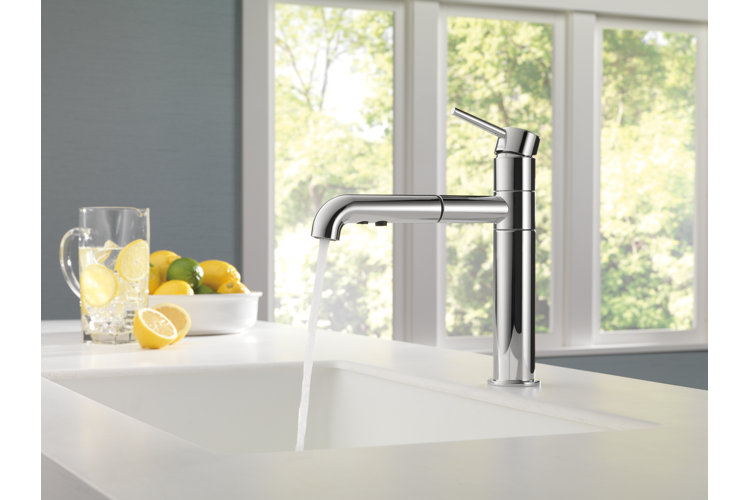
Essential to any functional cook space, a faucet is a kitchen fixture you'll use every single day. To find the types of kitchen faucets that are right for your space, review your current sink’s setup and consider how different styles will look on your counter. Then, read up on the top faucet types and configurations below in our kitchen faucet buying guide.
Kitchen Faucet Mounting Types
Before you decide on a kitchen faucet, examine your sink area. Do you already have a wall-mounted faucet set-up and no faucet holes on your kitchen counter? A wall-mounted kitchen faucet will be the quickest and easiest to set up in this case. Do you have a kitchen counter with faucet holes pre-installed and ready for a faucet hookup? All you need is to find a deck-mounted faucet with the right number of corresponding installation holes and that’s the right size to fit the space.
Below, we break down the two mounting types to choose from for your kitchen faucet so you can determine which one works best for your kitchen sink:
Deck-Mounted: The most common mounting type, this style of kitchen faucet is attached to the counter (also known as the "sink deck") or the sink itself. If mounted on the counter, enough clearance is needed between the sink and the wall behind it to easily turn handles and ensure the spout portion pours into the sink.
When choosing a deck-mounted faucet, it’s important to consider the number of installation holes your sink already has and the number of installation pieces in your new faucet. Deck-mounted faucets can have either one, two, three, or four corresponding holes to match the number of faucet holes already installed into your countertop by the sink.
These faucet holes connect your faucet and the faucet's handle to your sink's water supply. The more faucet holes, the more potential for options like a handheld sprayer, soap dispenser, freestanding faucet handles, and a freestanding faucet spout.
Wall Mounted: Typically paired with farmhouse sinks, this style of kitchen faucet is installed directly to the wall above your sink, freeing up counter space. Plumbing connections above the countertop are required for installation.
Standard Kitchen Faucets: Standard types of kitchen faucets come in a variety of shapes and sizes, and can be shopped to fit your sink's distinct installation needs.
Bridge Faucets: Typically only requiring two holes in your sink, wall, or countertop, this distinct-looking faucet has two handles with the spout suspended between them.
Bar Faucets: Due to its small size, this faucet is commonly placed in prep sinks or wet bars. Available in a variety of styles, bar faucets work with one- to four-hole configurations.
Pot Fillers: Designed to fill large cooking pots with water, these types of kitchen faucets are typically mounted on a wall above the stove. Pot-filler faucets typically require one to two holes for installation.
Water Dispensers: Water dispensers can be installed alongside your kitchen faucet, and are great for dispensing either boiling hot or cold drinking water easily and quickly. Many have a water heating tank, installed beneath the sink, that connects to the faucet and dispenses water hotter than a standard faucet can dispense.
Make washing dishes and filling drinking glasses a seamless, easy process by selecting a kitchen faucet spout with one or more of the following features:
Pull-Out/Pull-Down: Equipped with a flexible hose and retractable spray head, pull-out spouts are types of kitchen faucets that allow for easy mobility during rinsing and eliminate the need for a separate side spray. Pull-out spouts are ideal for small spaces. In contrast, pull-down spouts are types of kitchen faucets that have a high arc (or gooseneck) featuring a detachable spray head that extends directly down into the sink.
Swivel: Requiring a bit more space for clearance, swivel spouts are types of kitchen faucets that can be moved from side to side, allowing for better coverage of the sink.
Gooseneck/High Arc: The tall, arched necks of these spouts are not only gorgeous, but also great at cleaning larger pots and pans as these types of kitchen faucets hang above the sink and out of the way.
Touch-Activated: These tech-savvy faucets require a simple tap of the hand or wrist to turn on or shut off water flow.
Touchless: These cutting-edge spouts can be turned on and off with the wave of a hand, which helps keep your sink clean when your hands aren’t.
Built-In Water Filter: There’s no need to buy an extra water filtration system with these types of kitchen faucets – it’s built right in!
Water Filtration Systems: If you're set on a kitchen faucet that doesn't come with a built-in water filter, opt for a simple water filtration system that fits right to the faucet opening. Kitchen faucet water filtration systems provide clean, filtered water straight from the tap and you can remove them or replace filters with ease.
Additional Features to Consider
Kitchen Faucet Flow Rate: The flow rate of a kitchen faucet describes how much, how fast, and at what pressure water flows from a faucet. The average kitchen faucet flow rate is between 2 and 2.2 gallons per minute, which is also the maximum flow rate for kitchen faucets allowed by federal regulations. However, you can purchase a faucet aerator that screws to the end of the faucet to increase your kitchen faucet’s flow rate.
Mounted Soap Dispensers: Allows for easy hand or dish soap access through a container hidden beneath the counter's surface.
Deck Plates: A deck plate is the perfect solution if the types of kitchen faucets you are installing has fewer installation pieces than the number of holes already drilled in your sink. They cover unused installation holes and allow almost any faucet to work in any sink.
Faucet Finishes: We recommend coordinating your kitchen faucet with the other appliances in your kitchen. From durable stainless steel and copper to modern matte black, refreshing white, or sleek gold, there are so many ways to have fun with the style of your new kitchen faucet.
Handle Styles: Kitchen faucets typically have either lever handle styles or knob/cross handle styles. Lever handles are super easy to use with a quick turn of the handle inwards or downwards for faucets with a built-in lever handle. Knob/cross handle styles come in a variety of configurations for a more design-focused look that turns the faucet on or off by turning them left or right.
Number of Handles: Both lever and knob/cross handle styles either come in configurations of one or two. One handle is a common option for standard, bar, or pot filler kitchen faucets where turning the handle in a specific direction dictates the water temperature that comes out of the faucet. Faucets with two handles allow you to control hot water with one and cold with the other. Bridge faucets usually have two handle configurations.
Ready to find your next kitchen staple?
