How to Choose the Right Kids Bed
Best kids beds for growth.

When furnishing your kid’s bedroom, it’s important to find the right bed to ensure their comfort and safety as they grow. Keep reading to explore which beds are best for kids, as well as kids bed sizes and configurations designed for each stage of life.
1. Explore Types of Kids Beds
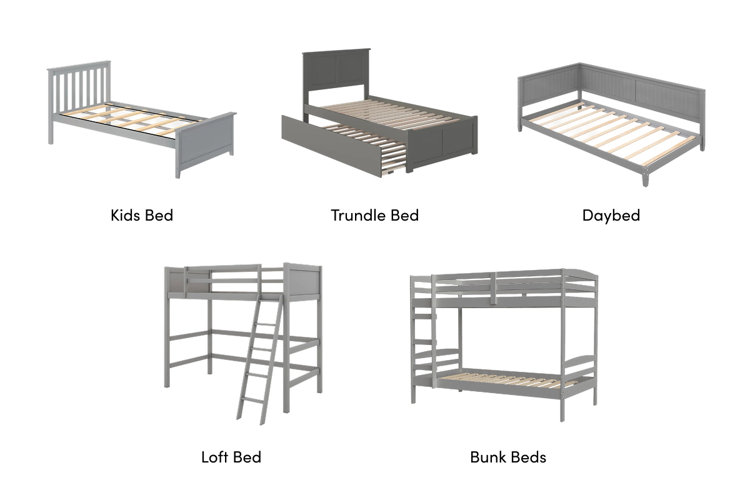
Choosing the right type of kids bed depends on your sleeping capacity requirements, available floor space, and the age and safety needs of your children. Explore these types of beds to find one that suits your kids bedroom:
Kids Bed: Kids beds are typically twin-size, though they come in a range of sizes to accommodate growing children. They usually feature a standard bed frame but also come in playful designs to add whimsy to children' s rooms. Their frames are often lower to the ground than an average bed to allow for easy access.
Trundle Bed: Trundle beds are standard bed frames that feature a pull-out draw to hide a second mattress under the bed. These are perfect for hosting spontaneous sleepovers or if your kids share a small bedroom, as the second mattress can be tucked away to save space when it’s not in use.
Daybed: Daybeds are designed to fit against a wall and typically have two or three closed sides – making them a safe choice for young children transitioning from a crib or toddler bed. This also makes them a space-efficient option for small bedrooms and they frequently include trundle beds as well.
Loft Bed: Loft beds are a single mattress on an elevated platform. The space underneath the bed can be used for a kids desk, play area, or lounge space – making them great for creating a multifunctional space. Children should be at least 6 years of age to safely access a full-height lofted bed with a ladder, though some designs come in shorter heights with built-in stairs to accommodate small children.
Bunk Beds: If you have two kids sharing a room, bunk beds are a great space-saving solution. They feature two stacked mattresses to accommodate twice the children in the same footprint as a regular bed – just be sure to measure your ceiling height. Similar to lofted beds, the top bunk is best for children 6 years and older.
Children’s beds range in size from toddler beds to standard queen size. Each size bed is designed to accommodate different age groups and space requirements. Read the descriptions below to help find which bed size is best for your child:
Toddler: Once your child is able to climb out of their crib, consider upgrading to the toddler bed. Toddler beds measure 28" by 52" and are built to fit a standard crib mattress – making it easy to transition from a crib to a toddler bed. They are low to the ground to promote independence and usually feature partial guard rails for your toddler’s safety. Toddler beds are intended for children between 18 months and 3 to 4 years old, or those shorter than 35" and less than 50 lbs.
Twin/Single: Once your child is more than 35" tall or exceeds the weight capacity of a toddler bed, it’s time to upgrade to a twin bed. Twin beds measure 38" by 75" and are typically used for children between the ages of 3 and 12 to accommodate their growth during elementary and preteen years. They are a practical choice for small bedrooms or shared spaces.
Extra-Long Twin: Extra-long twin beds are designed to give your kids more space during their teen years (13–19) when they begin growing rapidly. They measure 38" by 80" – the same width as twin beds but with extra length. Definitely consider an extra-long twin if your teen is estimated to grow over 6' tall. Twin XL beds are commonly found in college dorm rooms, guest rooms, and can even be used in small adult bedrooms in a pinch.
Full/Double: Full beds are 54" by 75" – the same length as a twin bed but with extra width. Full beds are best for preteens and teens that like to sprawl out when they sleep and provide ample room for growth so they can last for years in your child’s bedroom. Due to their size, full beds require a larger bedroom and more floor space to fit comfortably.
Queen: Queen beds are 60" by 80" and intended for children and teens 12 years and older. They provide the most space for growing teens and can even be used as guest beds when your children are grown and out of the house – making them a long-lasting fixture in your home.
Tip!
Keep in mind that bed frames add between 2" – 5" to the mattress dimensions above, so it’s important to review the product details tab for specific frame dimensions. Read more in How to Find the Right Bed Size for Your Space for measuring and placement tips.
3. Consider Bunk Bed Options
For shared kids rooms or guest rooms, bunk beds are the perfect sleeping solution. They come in a range of sizes and configurations to fit the layout of the bedroom and your space requirements. Check out these popular bunk bed sizes to find one that fits your family’s needs:
Twin Over Twin: Twin-over-twin bunks are the best bunk beds for children up to 12 years old sharing a bedroom, however children under 6 should not use the top bunk for safety reasons. Twin-over-twin bunk beds have the same 38" by 75" dimensions as a twin bed but require more vertical space. For young children using bunk beds, it’s important to choose a design with railings on the top bunk to ensure the safety of your kids.
Twin Over Full: Twin-over-full bunk beds are exactly how they sound: a twin-size top bunk above a full-size bottom bunk. This is a great type of kids bed if you have an older child sharing a bedroom with their younger sibling because it provides more sleeping space for the older child. They have the same footprint as a 54" by 75" full-sized bed.
Full Over Full: If you have two teens sharing a bedroom, it’s important to give them their own space. Full-over-full bunk beds are perfect for this scenario and provide ample sleeping space for both kids even when square footage is limited. Both the top and bottom bunks are the size of a 54" by 75" full bed – allowing room for growth and spreading out. If you have older kids sleeping in bunk beds, it’s important to check the weight capacity of each bunk for safety.
Extra-Long Twin: Twin XL bunk beds come in two styles: twin XL over twin XL or twin XL over queen. Compatible with a 38" by 80" mattress, twin XL bunk beds add an extra 5" of length to accommodate taller sleepers. This is a great option if you have teenagers sharing a bedroom or have a small guest room where you want to temporarily accommodate two adults.
Queen: You can include a queen mattress in two types of bunk beds: twin XL over queen or queen over queen. Either way, the bottom bunk will have the 60" by 80" dimensions of a queen mattress which makes it more comfortable for adult sleepers. Queen mattresses can even accommodate two sleepers to further increase the capacity of your room. Queen bunk beds are ideal for guest rooms where you want to maximize sleeping capacity or for shared teenage rooms to give each teen space to spread out.
Tip!
Interested in adding bunk beds to your kids room? Read A Quick & Easy Guide to Bunk Bed Sizes for detailed dimensions, layouts, and ceiling-height recommendations.
