What Is a Kitchen Range?
Find the perfect appliance.
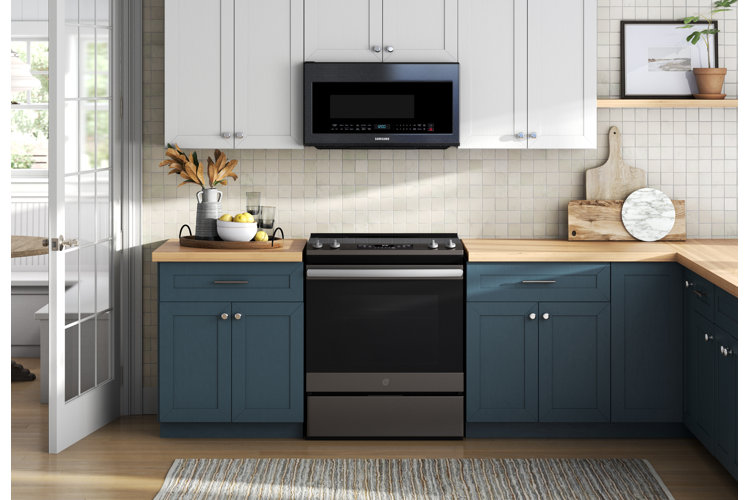
Whether you’re outfitting a new kitchen or upgrading an old appliance, choosing the right kitchen range is essential to your cooking setup. But what is a kitchen range and how do you choose one that fits your culinary needs? Read on to find out.
What Is a Kitchen Range?
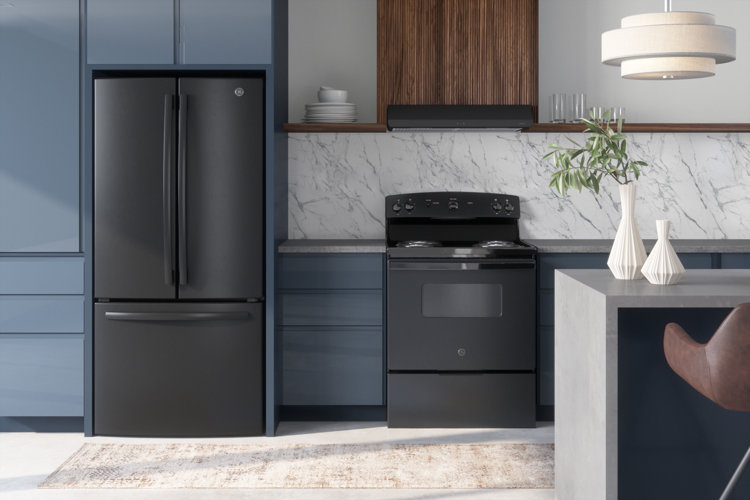
(Shop this image: gas ranges, leather bar stools, beige hallway runners, and drum pendant lights)
A kitchen range is a common multifunctional kitchen appliance that combines an oven and a stove top. Though you may refer to it as an oven or a stove, the appliance you use in your kitchen for both baking and stove-top cooking is likely a kitchen range. Here’s how to distinguish between the types of cooking appliances:
Oven: Ovens are enclosed compartments that are used to cook food. They can be sold without stove tops – these types of appliances are also called wall ovens. They’re often found in commercial or high-end kitchens.
Stove: Stove tops use their own fuel to heat a surface on which cooking can occur. In your kitchen, the stove top is most likely part of a range, equipped with four, five, or six burners. You can also find stove tops that are independent of kitchen ranges, called cooktops.
Tip!
Having trouble deciding which appliance is right for your kitchen? To learn more about the distinctions between ranges, ovens, and stoves, check out our related guides Oven vs. Range: How to Choose the Right One and Cooktop vs. Range: Which One is Right for Your Kitchen?.
How to Choose a Kitchen Range
1. Measure Your Kitchen
(Shop this image: dual-fuel ranges, glass pendant lights, gray bar stools, and french door refigerators)
Kitchen ranges vary in size, but the most standard size is 30" wide and 36" tall. That being said, getting the measurements right is essential to figuring out the best range size for your kitchen. First, designate the space in your kitchen where you plan to house the range. Then:
1. Measure the counter height: This will help you determine the right range height to line up with your countertops. If you have a freestanding range, you don't necessarily need to complete this step, but if you're all about aesthetics and uniformity, measuring the height of your countertops will ensure that your freestanding range matches your counters and looks like it belongs in your kitchen.
2. Measure the depth of the space: Measuring depth is super important to make sure a kitchen range doesn't stick out farther than your kitchen cabinets, for both aesthetic and safety reasons. Place your measuring tape on the front edge of your bottom cabinet and measure to the wall the range will rest against to figure out the best depth for your kitchen range.
3. Measure the width of the opening: For freestanding ranges, this might mean measuring the width from the cabinet to the wall or a doorway. For slide-in or drop-in varieties, this might mean measuring from cabinet to cabinet to determine how wide the space is between them. You'll need about 1/4 to 1/4" of space between the range and the side of the cabinet for smooth installation.
2. Factor in Size & Cooking Capacity
(Shop this image: electric ranges, wall-mounted range hoods, beige bar stools, and bowl pendant lights)
Now that you’ve determined what size range will best fit your kitchen, it’s time to explore your options thanks to the guide below.
20" & 24": 20" and 24" ranges are considered compact-friendly options for smaller kitchens or apartments. They typically have 1.99 to 3 cu. ft. of space in the oven. They’re the perfect size to use to make a small casserole or rotisserie-size chicken to enjoy with one or two people.
30" & 36": As mentioned, 30" and 36" ranges are the most common, standard-size options that accommodate cooking for about four people. The oven space of these ranges varies from 3 to 6.99 cu. ft., so choosing one of these two range sizes gives you plenty of room and variety.
48" & 60": 48" and 60" ranges are meant for large kitchens where the goal is to cook, bake, and then bake some more. Most ranges of this size come with double ovens: one smaller, more compact oven with anywhere from 2 to 3 cu. ft. of space, and a larger oven with anywhere between 4 to 7 cu. ft. of space to accommodate a wide range of roasting, broiling, or baking all at once.
(Shop this image: gas ranges, over-the-range microwaves, bulb pendant lights, and farmhouse sinks)
Ranges come in three types – freestanding, slide-in, and drop-in – that differ based on their installation method. Here are the benefits of each:
Freestanding: This type of range has finished sides and prominent legs that allow it to stand independently of a countertop. Freestanding ranges tend to take up more room than slide-in or drop-in ranges because they have finished sides, meant for standing alone, and can even include their own overhead storage. You have a lot of freedom when placing a freestanding range in your home, as many electric styles can be simply plugged into an outlet. When choosing a spot to install your freestanding range, remember to choose a spot with an electrical hookup, or in the case of gas ranges, a gas-line connection.
Slide-in: Meant to fit snugly into a kitchen countertop, slide-in ranges don't have finished sides and tend to be a bit more compact than freestanding ranges. A slide-in range needs to be installed into a countertop with the proper cutout. Once installed, slide-in ranges give the impression of a sleek built-in look. They also offer close proximity to counter space for prepping ingredients and plating dishes.
Drop-in: Drop-in kitchen ranges are anchored between cabinets. Hence the phrase "drop-in," the range gets directly wired to the wall and usually rests on top of low-set cabinet drawers that match the surrounding cabinetry, rather than having the typical oven bottom drawer. Drop-in ranges have a built-in look that's perfect for kitchen islands.
(Shop this image: dual-fuel ranges, leather bar stools, wall-mounted range hoods, and glass pendant lights)
Each fuel type offers its own benefits, whether you're a seasoned at-home chef or just in need of a dependable kitchen range. Figure out which range fuel type you need, below:
Gas: Gas ranges are especially good for stove-top cooking. They heat quickly and allow for precise temperature adjustment, which makes them great for more seasoned cooks. These types of ranges use natural gas as fuel. This means you'll save more on your energy bill, especially if you already have a natural gas-supply line. Gas stove tops are available in two styles: grate and deep-recessed. On both, the gas burners are covered by removable grates on which cooking occurs. The top of deep-recessed grates are level with the top of the range, while grate stove tops protrude above the range slightly.
Electric: Electric ranges offer more precise temperature control in the oven, which is excellent for avid bakers. Powered by electricity, electric ranges are easy to install and operate. The stove-top surface on glass-topped electric ranges is smooth, which allows for easy cleaning. Electric ranges are also available with a coil-style stove top, which allows for faster cooking when compared to glass-top models. Electric ranges are less expensive than gas ranges and typically cost less to install, but they can add to your monthly electric bill.
Dual-Fuel: Get the best of both worlds with a dual-fuel range that has a gas-powered stove top and an electric oven. With a dual-fuel range, you'll have more precise control of the temperature of both the stove top and the oven. These appliances are ideal for devoted bakers and chefs who prioritize having more control over their cooking.
Tip!
Explore the pros and cons of the different fuel types by reading our article Gas vs. Electric Stove: Which One is Right for You?
5. Consider Additional Features
(Shop this image: electric ranges, wooden bar stools, green hallway runners, and cone pendant lights)
Convection: Using an internal fan to circulate heated air, convection ovens cook food more quickly and evenly.
Air-Fry: Skip an air-fryer and save counterspace when you choose a range with an air-frying mode to give you extra-crispy food.
Quick Boil: Quick boil ranges can also be called power boil burners and are designed with a larger heating element to boil liquids faster than a standard burner.
Self-Cleaning: Self-cleaning ovens heat up to extreme temperatures in order to turn any baked-on residue into ash for a simpler cleaning process.
Double Oven: If you're an avid chef, you may want a range with more cooking capacity. A double oven allows you to cook two dishes simultaneously at different temperatures.
Wi-Fi Enabled: Wi-Fi-compatible kitchen ranges use smart technology to give you more flexibility – like the ability to preheat the oven from your phone over wifi.
