What Is the Average Kitchen Size?
Function & square footage.
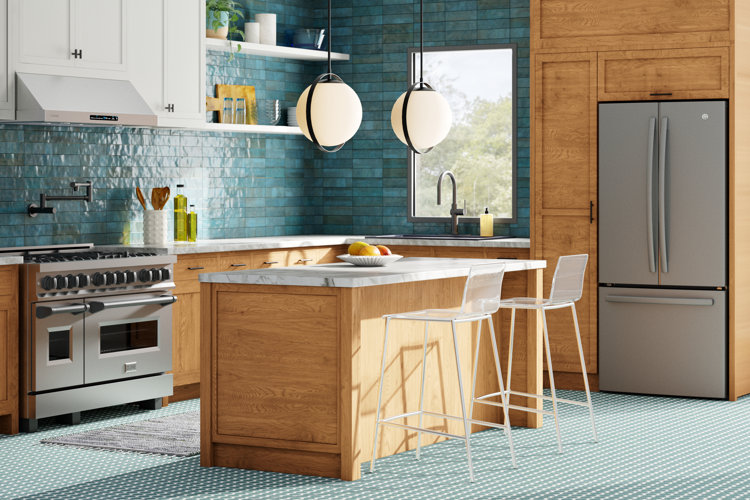
Designing a kitchen is no small task. Viewed as the heart of the home, there are a number of factors to take into consideration when you are planning the layout or selecting appliances for your kitchen – including more than just simple food preparation. Keep reading to learn about the average kitchen size for different homes and the various layouts available to help you plan a remodel.
1. Average Kitchen Size by House Square Footage

(Shop this image: white bar stools, black pendant lights, mid-century modern dining room sets, and mid-century modern backsplash tiles)
Before you consider kitchen sizes, you need to look at homes first. When you include residential homes, townhouses, and condos, the average home size is around 1,500 sq. ft. – although this does vary according to the age of the home and if any kitchen renovations have occurred.
Many newer homes come in at around 2,600 sq. ft., with the kitchen being proportionate to that size. When considering kitchen measurements, it's also important to remember the home location. Suburban homes will have more space for the kitchen than smaller urban homes and apartments.
1,500 sq. ft.: The standard single-story home has an average kitchen size measuring as little as 103 sq. ft. and going up to between 161 and 169 sq. ft. or 13 ft. x 13 ft. This increases to 174 sq. ft. in double-story homes. This number is typically used as a benchmark for the kitchen cabinet industry when determining renovation costs, though modern homes are usually larger than this.
Under 2,000 sq. ft.: Homes of this size average at around 195 sq. ft. for the kitchen. This allows enough room for both a food prep and socializing in the space.
Between 2,000 & 2,900 sq. ft.: Homes ranging between these measurements often have an average kitchen size of about 288 sq. ft. This falls onto the scale of what standard kitchens in more modern homes measure – although those numbers do differ greatly, ranging anywhere from 180 sq. to 440 sq. ft.
3,000 sq. ft. & Over: Larger homes of this size will usually feature luxury kitchens of around 424 sq. ft. This is ideal for big families or those who cook often and like to entertain frequently or spend time in the kitchen.
Tip!
If you are considering installing new cabinetry in your cooking area, read Kitchen Cabinet Sizes: Which Are Right for Your Space? and How to Measure Kitchen Cabinets for Custom Cabinetry.

(Shop this image: teal kitchen backsplash tiles, orange bar stools, multicolor kitchen mats, and modern flower vases)
Over time, the average kitchen size of newly built homes has increased significantly as the purpose and use of the space has altered slightly. Today, people are looking for more in their kitchens beyond simple food preparation. Larger appliances, bigger pantries and storage options as well as dining and social areas are all sought after – but how does this differ from the past?
Pre-1900s: Kitchens were extremely small and usually hidden from the rest of the home. Large freestanding appliances like the stove and fridge took up most of the floor space and food was stored in separate pantry areas.
Early 1900s: Kitchens were small and utilitarian, separated from any dining or living areas as they were simply used for food preparation. Manufacturers started making electric appliances and cabinetry smaller to make the space more functional and efficient. Sometimes you could find informal dining areas were present in some kitchens, although this wasn't common.
1950–1980: As homes began increasing in size, the kitchens grew slightly. This was to incorporate a dining space as families began informal dining together at small tables or breakfast nooks. Appliances continued to shrink as built-in options like wall ovens became more popular along with efficient cabinetry designs.
1980–2000s: Kitchens grew even more as they began to serve social functions, blending the cooking area and entertainment space into one. Many families shared meals in their kitchens, whether at the island, in a breakfast nook, or at a table. Guests often gather in the kitchen too which is why many older homes have undergone renovations to increase the average kitchen size.
Present Day: Kitchens continue to grow in size as average home sizes increase. They are not used only for cooking as the open-concept layout integrates the kitchen with the living area, creating multifunctional spaces for all to enjoy. Appliances come in a range of sizes and designs are more varied to better accommodate the various shapes and sizes of each kitchen.
(Shop this image: geometric kitchen backsplash tiles, backless bar stools, black pendant lights, and tiered wall shelves)
Another factor that will determine the size of your kitchen is the layout. Each configuration will have different square footage as they are all designed to make the most of the space.
One-Wall: One-wall kitchens are among the smallest in size, with all appliances and cabinets along one wall. Since one-wall kitchens are usually found in open-concept and studio apartments, it can be difficult to measure their square footage, though they typically require between 8–10 ft. of wall space to accommodate basic appliances.
Galley: Also known as a walk-through kitchen, this comprises two walls of cabinets, countertops, and appliances facing one another with a walkway running through the middle. This design is best for apartments and small spaces since it makes the most of limited square footage while still providing sufficient storage and work surfaces. On average, a galley kitchen is around 100–150 sq. ft. or around 7 to 12 ft. wide with around 4 or 5 ft. for the walkway.
U-Shape: Medium spaces work well with U-shaped or horseshoe kitchens. This layout features the refrigerator, stove, and sink each on one wall, making cooking and cleaning more efficient and allowing for easy movement in and out of the kitchen. In general, these kitchens measure around 150–250 sq. ft.
L-Shape: This layout is one of the most common thanks to its versatility and compatibility with most homes. It consists of two perpendicular walls of appliances, cabinets, and counters that can vary in length based on the amount of space available. The L-shape offers an open-plan layout which allows for plenty of workspace and room to add a dining set if you wish. In general, this design measures around 150–200 sq. ft. or between 8 to 13 ft. long and 3 to 9 ft. wide.
Island: This type of kitchen has a number of configurations but will always feature a free-standing kitchen island that is typically placed in the middle of the space. Depending on your preference, this island can be used as an extra workstation, feature cabinets, and/or be used for casual dining. Some islands can even have a cooktop or sink. This layout requires a fair amount of space, starting from 200 sq. ft. and up with the island itself measuring around 3 by 6.5 ft.
Peninsula: This layout is similar to the U-shape but with the third wall of the horseshoe featuring a connected island that can be used for both storage and dining. It blends the openness of an island kitchen with the efficiency of a galley and ranges from 150–250 sq. ft in size.
Tip!
Want to learn more about different kitchen layouts? Read
- Types of Kitchen Layouts for a Perfect Floor Plan
- What Is a Galley Kitchen & Will It Work for You?
- Kitchen Island Designs & Dimensions
4. Measure Your Kitchen for Appliances
(Shop this image: low-back counter stools, wall-mounted range hoods, stainless steel ranges, and stainless steel refrigerators)
Choosing the right appliances for your kitchen size is vital to making the most of the space. There is no sense in selecting a massive two door fridge in a small galley kitchen, so you need to take into account your kitchen layout and cooking needs to determine what size appliances will work best.
Range: A range is the most vital appliance in the kitchen. The width is the measurement you will need to work with, although there are additional considerations such as number of burners, oven capacity, and fuel type. For help selecting the right range size for your space, our guide Stove Sizes: How to Choose the Right Fit for Your Kitchen) is worth a read.
Refrigerator: Next is the refrigerator – these range anywhere from small freezerless refrigerators to large side-by-side options. In addition to the type of fridge, other sizing options include the refrigerator capacity, depth, and width. Have a look at Refrigerator Dimensions: What is the Standard Size of a Refrigerator? and The Ultimate Refrigerator Buying Guide for more sizing info.
Dishwasher: While a dishwasher is not a necessity, it is a nicety that most kitchens offer. You can use the width to determine the size that will best work in your space. Look at Dishwasher Sizes: How to Find the Best Dishwasher Size for Your Kitchen for extra guidance.
Tip!
For any additional information you need about appliance sizing in your kitchen, our guide on
How to Measure for Major Appliances: Choose the Perfect Sizes for Your Home will help you out.
