Earn {RICH_TEXT_POTENTIAL_REWARDS} in rewards, with 5% back¹, plus more exclusive perksEarn $17.00 in rewards, with 5% back¹, plus more exclusive perks
FREE Delivery
Get it Mon, Jul 13 - Fri, Jul 17
Show Related CategoriesCategory
to:
Figurines & Sculptures
Decorative Book
Vase Fillers
Statues
Piggy Banks
Busts
Hourglass
Cloches & Water Globes
Crystal
Letter Blocks
Decorative Bird Houses & Cages
Decorative Plaques
Decorative Puzzles
Finial
Decorative Telescope
Decorative Wine Cork Holder
Modern
Country / Farmhouse
Mid-Century Modern
Traditional
Coastal
Boho
Farmhouse Inspired
Gold Figurines
Beach, Coastal & Nautical
Boho
Silver Figurines
Modern Accents
FREE Delivery
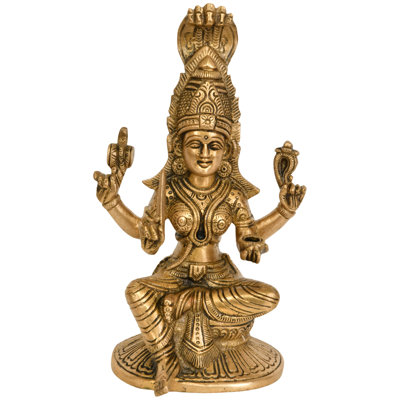
Uma is one of the manifestations of the divine feminine energy, the Devi, who has different forms such as the kind Shiva’s consort, Parvathi, the fierce Durga, or the destroyer of evil, Maa Kali. Uma is the other half of Shiva’s divine energy, the energy that brings everything closer and connects the dots, and is confident and gracious in nature. Uma is said to be the embodiment of Shiva’s first wife, Sati. This feminine divine goddess is said to possess all the qualities that make her a generous giver to the Universe and is considered as the light that dispels all the darkness. Uma in this gorgeous statue indicates unconditional love that goes beyond self-sacrifice and adjustments to keep loved ones happy. Uma can be seen seated with her right arm retained to hold a lotus while she keeps her left hand on the pedestal. Her braided hair is arranged into a mukut that resembles Shiva’s, representing that the two energies are intertwined. Uma brings with her the feminine energy of creation, sensuality, divinity, and love.
FREE Delivery
Trimukha Ganapati, the 28th among the 32 distinct forms of Ganapati, stands as a unique and benevolent manifestation of the Lord. With two serene heads cradled on his four divine arms, his presence exudes a sense of grace and power. On one hand, he carries the iconic abhaya mudra, a gesture of fearlessness and protection, while his other arm indulges in the Lord's favourite delight, the modak sweet.Devotees believe that Trimukha Ganapati watches over them and their families, ensuring their well-being and success. When approached with unwavering faith and devotion, this divine form is said to bestow victory and triumph upon his worshipers, guiding them towards success in every endeavour. Discover the divine energy and blessings of Trimukha Ganapati as you invite this auspicious form of Lord Ganesha into your life. His presence is believed to inspire confidence, remove obstacles, and lead you on the path to success.
FREE Delivery
Ganesha here is presented as Narthan Vinayakara (in Tamil) or Nritya Ganpati- one of the 32 forms of the elephant god in Hinduism, where he is seen dancing vibrantly (narthan and nritya both suggest dancing). His posture and elegance remind one of the Tandava of Shiva and Laasya of Parvati. However, while Shiva dances to destroy and Parvati to create, Ganesha’s dance has not been endowed with such meanings. It seems as if our favourite Lord Ganesha dances to celebrate- to preserve and relish the life that occurs in between creation and destruction. This dance of Ganesha as the supreme reality has been a prime theme among the Ganpatayas- a sect based around Ganesha as their tutelary god, along the lines of the Ganesha Purana and Mugdala Purana.Coming to the outward features, the fabulous Karandamukuta (crown shaped like a pot) on Ganesha’s majestic head looks strikingly similar to a mountain. The well-known Indian poet Somadeva in his Kathasaritsagar has alluded to this similarity, comparing Ganesha’s head to the great mountain Meru (the centre of the Universe). Kirtimukha or the face of glory adorns the centre of the crown (also seen on the ornate waist belt of the lord). Tripunda (a distinctly Shaivite mark) can be seen on Ganesha’s forehead below the chains of the crown and a floral motif. His eyes are animated- looking at the idol from any direction will give you the feeling that you are under the omnipresent gaze of Ganesha. A bell is tied to his stylistically designed trunk. Imagine the sound it produces when the lord flings his trunk in the joy of dance! His ears, looking similar to a winnowing basket used in rural India even today, have birthed the belief that like the basket, Ganesha has the ability to separate the Gyan (useful) from the Agyan (useless). In his four hands, Ganesha has the goad, his broken tusk, a citron fruit, and a noose. The protruding belly that has added to the monumentality of the idol is a piece of art in itself. Embellished with elaborate udarbandh (belly belt), strings of which are interspersed with the coils of the great snake Vasuki (king of snakes), the tummy of Ganesha is believable as the abode of all the creation (as mentioned in the Mudgala Purana, a text dedicated to Ganesha as the ultimate reality). The plump legs of Ganesha are placed in the most dynamic posture- the stateliness of the size softened and instantaneously amplified by the sense of movement that is added by the positioning of the legs. Dancing sublimely Ganesha is in the Kshipta position- left leg taking the weight of the body and right leg raised in the Kunchita step. Underneath his left leg is a newly blossoming lotus flower- a symbol of creation. Near his right leg, is his mount and devoted follower, Mushak (rat). The mammoth figure of Ganesha is situated atop an equally huge pedestal- four-tiered, decorated with the lotus petal motif, and having an upturned lotus flower as the third and fourth levels. Four dwarfs sit on each side, with weapons in their hands. They are identified as Ganas or attendants of Ganesha- the Ish or lord of Ganas. Though small in size when compared to their master, the Ganas are large enough to have received ample attention for their ornamentation, form, and posture. The last part of the platform has two holes running through it. This is a feature of Utsava Murtis (processional images) in South Indian temples, in which rods are passed through the holes and the idols are carried around the temple arena for devotees to greet their lord. Can you imagine, this gigantic Ganesha murti being carried on the shoulders of his dedicated followers, dancing as the crowd of his devotees follow suit? Kudos to the makers of this grand visual chronicle. Keeping in mind the size of this Ganesha idol, it is almost certain that the artist would have been unable to see one side of it while working on the other. The final detailing and symmetry have been made possible only by the hard work and dedication of the Swamimalai artists, for whom the craft is no less than a sacred ritual. The choice of bronze for casting this breathtaking idol is appropriate. Only something as timeless as bronze can ideally capture the ageless Indian philosophy. Appreciating the skills of the artists and priding our luck on being a part of His macrocosm, gazing at the Mahakaya Mahaganpati, savouring the atmosphere created by his commanding presence, we cannot help but feel an affinity to the rat that looks up at his lord in astonishment and veneration.
FREE Delivery
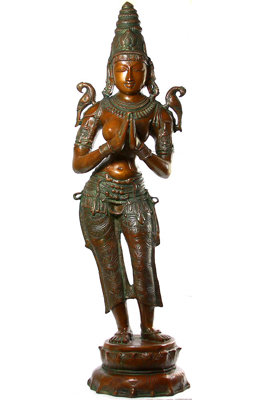
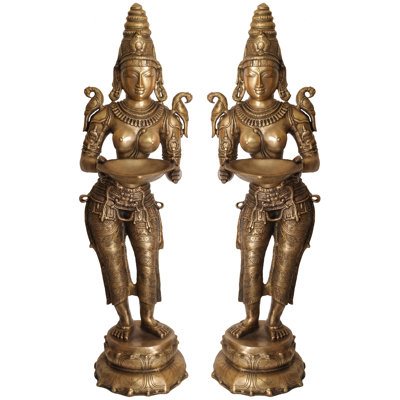
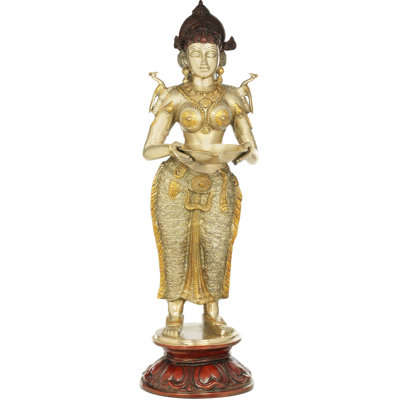
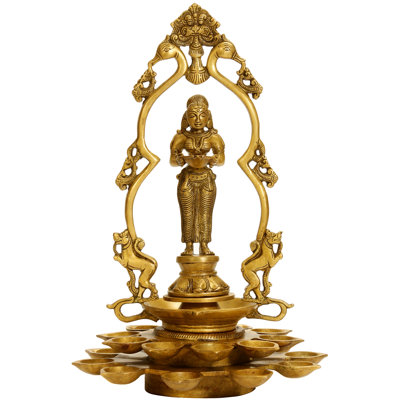
Illuminate your home with the timeless elegance of this 13-inch Brass Deepalakshmi Sculpture, a functional work of art that serves as both a traditional oil lamp and a symbol of divine hospitality. Handcrafted by master artisans in India, this statue depicts a celestial maiden (Apsara) holding a votive lamp, framed by a magnificent "Mayura Prabhavali" (Peacock Arch). In Indian culture, the Deepalakshmi is placed at the entrance of a home to welcome guests with light, signifying the removal of darkness and the ushering in of prosperity and auspicious energy. Cast in solid brass with a warm, golden finish, the figure is adorned with intricate jewellery, a "stana-pata" (breast band), and elegantly pleated garments that showcase the fluidity of the metalwork. The surrounding arch features dual peacocks—symbols of grace and beauty—enhancing the statue's regal presence. Whether used as a functional diya during Diwali and festivals or displayed as a year-round statement piece in your foyer or living room, this heirloom-quality sculpture radiates warmth, culture, and sophisticated craftsmanship.
FREE Delivery
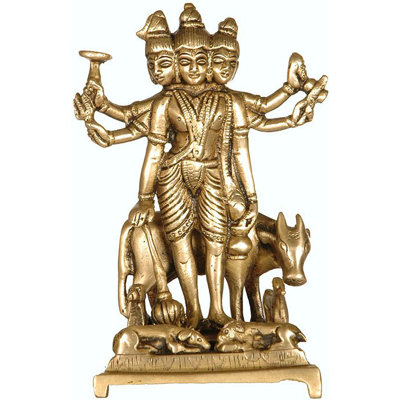
Lord Dattatreya is the presiding deity over yoga. He is a Trimurti avatar, a manifestation of the Brahma-Vishnu-Shiva trinity, who traverses the mighty peaks and the gentle foothills of the Himalayas. He is the divine renunciate, the Adiguru of the Adinatha Sampradaya, and a personification of Lord Adinath (Shiva) Himself. The murti that you see on this page depicts Lord Dattatreya in the company of the sacred Taumata (Mother Cow) and four dogs, each representative of one of the four Vedas.
FREE Delivery
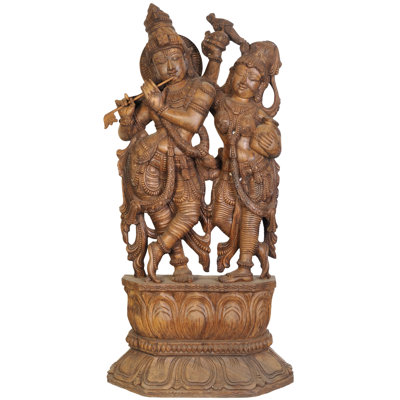
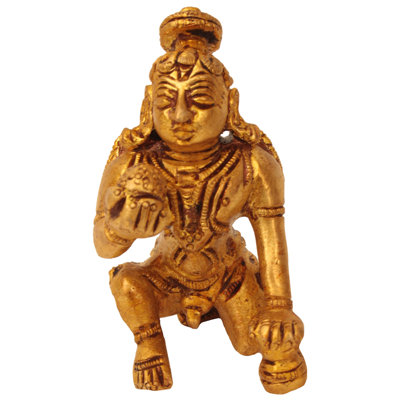
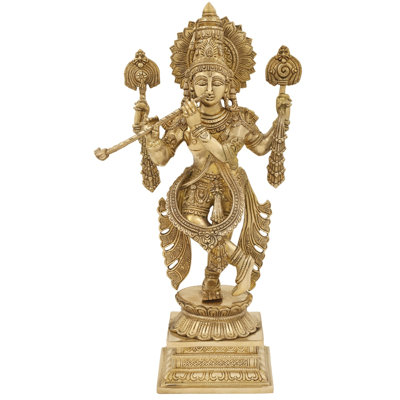
Lord Krishna is as handsome as Lord Gopala, His baa la-Roopa (infant form), is adorable. Since His arrival in Vrindavan from Mathura, He had won the hearts of the local mothers and maidens alike. The murti that you see on this page captures Him in the signature Tribhanga stance and, as such, is a visual narrative that explains the amorous aspect of His Leela (divine conduct). A small, oval-shaped face. Bright eyes complemented by a dreamy brow. The Vaishnava tilaka is indicative of the fact that He is a Vishnu-avatar. A tall crown and a supersized halo contrast with the delicate proportions of that handsome face.