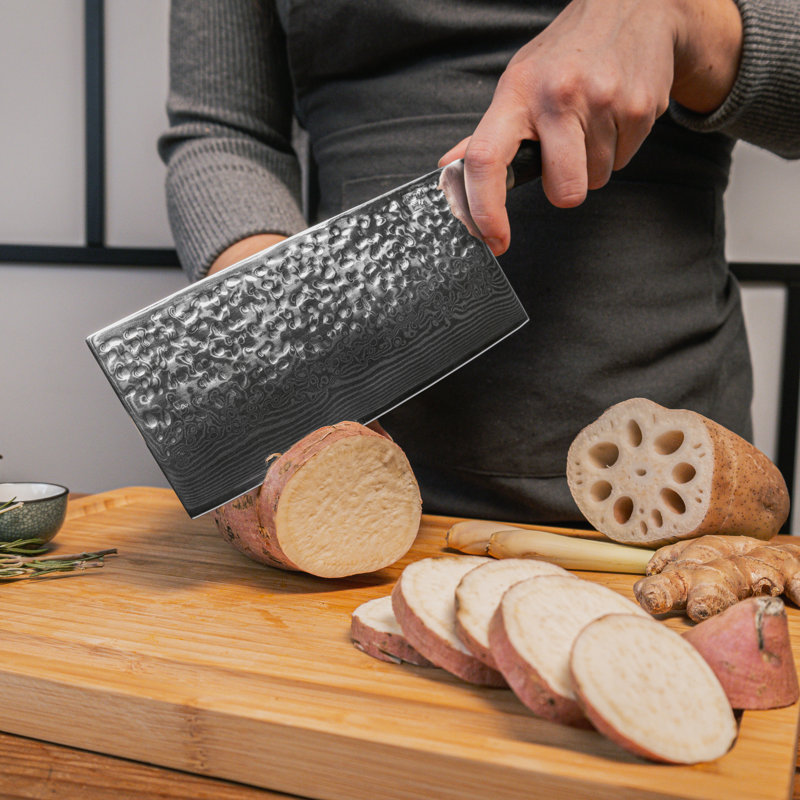
Damascus Steel Cleaver, 19 cm blade. Often called Chinese cleaver (中華包丁 chukabocho), its broad blade is ideal for cutting large chunks of meat, preparing spare ribs or quickly chopping hard vegetables without tiring your wrist.
Damascus Steel Cleaver blade is forged with AUS-10 steel, a premium steel that combines a high carbon content for hardness and edge longevity with the optimal amount of chromium to prevent oxidation.
Japanese precision, Western robustness.
The best of both worlds.
* handmade
* Ultra-sharp Japanese AUS-10 high-carbon stainless steel
* Hidden full tang
* Black pakkawood handle
* HRC hardness: HRC 61 +/- 1
* Weight: 339g
* Perfectly balanced
* Stainless
* Bamboo Saya (sheath or blade cover) included with each knife
* Lifetime warranty
The flat surface of the blade also makes a great tool for crushing garlic, nuts or ginger.
Plus, its wide blade gives it the ability to scoop up your chopped and sliced ingredients safely and transfer them to a container or pan. Its 2.5 mm thin blade allows precise and sharp cuts, never crushing even the most delicate food to preserve their full flavour.
Besides its aesthetic appeal, the “Tsuchime” (槌目) (hammered) pattern creates tiny pockets of air between the blade and the food being cut. This ancestral Japanese method reduces drag, thus preventing food from sticking to the blade.
Damascus steel is composed of a layer of very hard steel - here AUS-10 - for the cutting edge, surrounded by 66 successive layers of softer steel to protect the core layer.
This type of blade makes it possible to combine the advantages of a very high carbon steel - the layer of AUS-10 at the heart of the blade reaches an HRC hardness of HRC 61 +/- 1 - with the advantages of “softer” steels, such as resistance to impact and corrosion.
The blade thus forged from 67 layers of steel has an exceptional edge retention, while benefiting from increased durability and resistance to chipping.
In addition to these mechanical properties, damascus steel is appreciated for its aesthetic qualities because no damascus blade will have exactly the same patterns; each knife is unique.