Choosing Freezers: Upright vs. Chest Models
Which will best accommodate your frozen food needs?
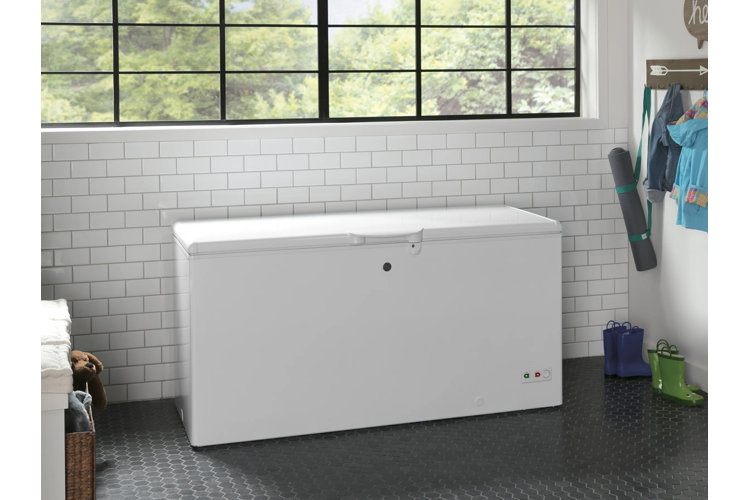
The right freezer allows you to preserve meat, fruit and vegetables, and a variety of frozen foods that would otherwise go bad. This helps you save money and ensure you don't waste food. Upright and chest freezers each have their own unique features and benefits. Compare and contrast these two freezers: upright vs. chest to determine which one offers the right price range, storage needs and design, size, energy-efficiency, long-term durability, and any other must-haves on your list of criteria.
Upright Freezers vs. Chest Freezers
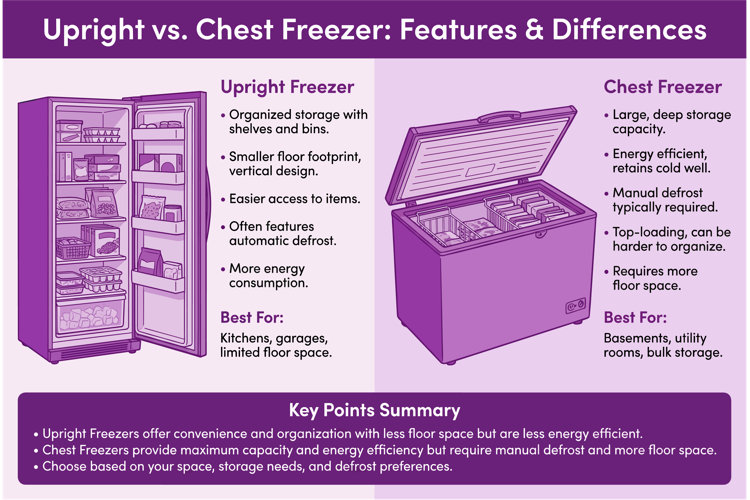
Before weighing the pros and cons of upright and chest freezers, we need to define them. Upright freezers have the same appearance as a normal household refrigerator – except the interior is all freezer space. Chest freezers are wide and lower to the ground. Both of these freezer types come in a range of designs, finishes, and storage capacity sizes. Review this section for all the information you need to make a well-informed decision about freezer options.
Tip!
Read over Your Guide to the Best Freezers: Freezer Types, Features & More for a comprehensive overview of freezer options and features.
Affordability
Winner: Chest Freezers
Chest freezers are more budget-friendly because they have a much more simple design compared to upright models. The large, open-storage compartment and lift-top configuration may lack in features, but makes up for it in price. Small chest freezers start around $300, while large and extra-large models can be up to $1,000 or more.
Even though chest freezers rank number one for affordability in the upright vs. chest freezer debate, the price range for upright freezers isn't far off. The average upright freezer is only a few hundred dollars more compared to chest freezer prices. In fact, most mini/small upright freezers average more or less $300, equal to chest freezer prices. However, larger upright freezers tend to go for over $1,000 due to their space and interior storage features.
Lower energy costs also make chest freezers more affordable when compared with upright freezers. More on this topic in the Energy-Efficiency section.
Design and Opening Configuration
Winner: Both
When choosing between freezers: upright vs. chest, both offer functional designs, depending on what you're looking for.
An upright freezer looks like a standard refrigerator in size, and it features interior storage shelves and a traditional door-opening style. This is an ideal freezer design if you want the same ease of use you get with refrigerator storage.
Chest freezers are typically waist-height and wider than upright varieties. Like normal chests, chest freezers open from the top with a single or double lift-lid configuration to provide access to frozen goods. These freezers have little-to-no storage compartments inside.
Storage Capacity
Winner: Both
When deciding between freezers: upright vs. chest, storage capacity should be a key factor. Because both chest and upright freezers come in varying sizes, you're bound to find a storage size that meets your needs.
Upright freezers have interior shelves and drawers for storing a variety of small and medium-size frozen food. However, if you want to store large cuts of meat, fish, and other large-scale frozen goods, we recommend going with a chest freezer. Chest freezers typically have one large storage compartment free from dividers or shelves so you can really amp up your storage space.
Tip!
Review Your Guide to Chest Freezer Sizes to determine which chest freezer size is right for your household.
Organization Capabilities
Winner: Upright Freezers
Upright freezers have shelves and drawers like a refrigerator, so naturally, they take first place for organization when compared with chest freezers. You can use built-in storage compartments to organize and separate frozen bread, fruit, vegetables, meat, and other items like ice cream, so you always know where to look.
Some chest freezers come with built-in storage baskets, but you can also insert your own freezer baskets/dividers to separate cuts of meat, frozen fruit and vegetables, and more.
Tip!
Get organized with The Ultimate Guide to Freezer Organization.
Longevity (Lifespan)
Winner: Chest Freezers
Chest freezers usually last longer when compared with upright freezers. In addition to the lifespan mentioned by the manufacturer, most chest freezers can function for up to 15 years or more. This is likely due to their quality minimalist design and lower energy usage that prevents the freezer from working too hard. Upright freezers usually last up to 10 years unless specified otherwise. This is because they use up more energy on average to keep interior compartments cool and to maintain defrosting capabilities.
When comparing chest vs. upright freezers based on lifespan, it all comes down to how often you clean and service them throughout the years. The better care you give, the longer use you can get out of them.
Small Space Requirements
Winner: Upright Freezers
When it comes to being small space-friendly, upright freezers are the way to go. This is because upright freezers take up more vertical space than horizontal space. This makes an upright freezer perfect for a spare corner in your kitchen, laundry room, or garage. You can also purchase upright freezes in half-size and mini configurations to meet your space requirements.
Although chest freezers are long and wide in comparison, there are slimmer models available. Narrower chest freezers have deeper storage cavities to make up for less horizontal storage.
Install Requirements
Winner: Both
Upright and chest freezers are equally easy to install and set-up. Each plugs into a standard household outlet (120V/240V) and requires a few hours or more to reach adequate freezing temperatures. Like with all freezers and refrigerators, you may need to leave the unit unplugged and in its upright position for up to 24 hours to allow the refrigerant to settle. This is only necessary if you have to put freezers on their side to store or move them.
Accessibility
Winner: Upright Freezers
Upright freezers offer better accessibility to your frozen food because of their interior layout. This freezer's vertical storage system, shelves, and drawers make it easy to survey the contents of the freezer at eye-level. Therefore, upright freezers allow you to quickly find and grab the items you need.
In contrast, chest freezers may require some digging in order to find food items beneath layers of frozen goods. You can remedy this by adding freezer storage baskets along the top section of the freezer for go-to frozen food items.
Energy-Efficiency
Winner: Chest Freezers
Chest freezers have tighter seals, which minimizes the amount of cold air that escapes. This means less energy goes toward compensating for temperature changes within the freezer, and therefore keeps energy bills lower. Tightly-sealed chest freezers also keep frozen food cold whether you have power or not.
Upright freezers don't have the same sealing mechanisms as chest freezers because of door frame gaps. This makes them more prone to higher energy-related costs as more cool air slips through. You can add your own seals to upright freezer doors to minimize the amount of cold air that escapes.
Noise Output
Winner: Chest Freezers
When deciding between freezers: upright vs. chest, noise-level is a necessary consideration. Chest freezers usually emit less noise than upright freezers because they don't have the auto-defrost feature. In contrast, upright freezers operate on alternating cycles to prevent a build-up of ice while maintaining an adequate cooling temperature. This causes a frequent humming noise in upright freezer models.
If you plan to put your freezer in a garage or basement, noise may not be a factor you need to consider.
Cleaning & Upkeep
Winner: Upright Freezers
Upright freezers are typically easier to clean and maintain because of their eye-level storage compartments and auto-defrost features. Some upright freezers have removable storage compartments that you can take out to clean more thoroughly. In contrast, chest freezers with deep storage compartments may require long-handled cleaning tools to reach the bottom portions of the chest. You may also need to manually defrost your chest freezer every six months to a year to remove ice build-up.
Browse our selection of freezers, now.
